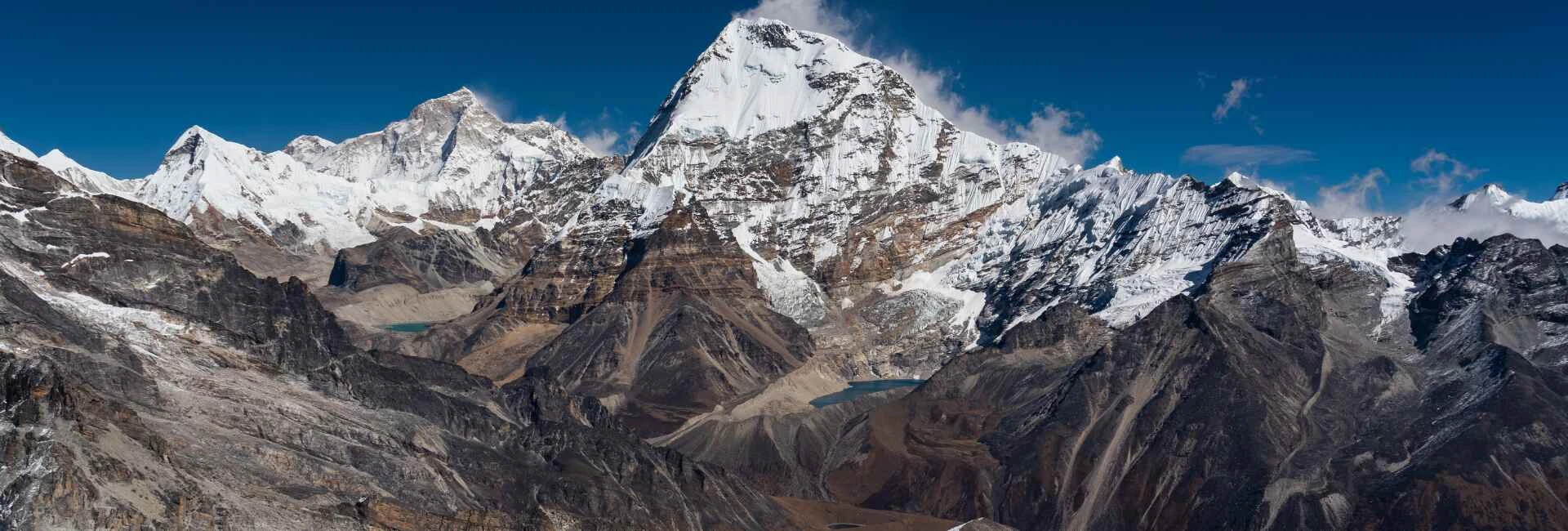
Every serious trekker who's stood at Everest Base Camp with the wind cutting through three layers, or crossed the Thorong La pass at 5,416 meters gasping for air, eventually asks the same question: what's next? For a lot of them, the honest answer isn't another trek. It's a peak.
This guide is written from firsthand experience. Ajit Adhikari has been guiding trekkers across Nepal since 2007, when he started out as a porter before working his way up to a qualified, government-licensed trekking guide. He's led groups through Annapurna, Manaslu, Langtang, Everest, and Mustang, and beyond trekking, he's personally stood on the summits of Island Peak, Lobuche Peak, and Mera Peak himself. That combination of on-the-ground trekking experience and real peak-climbing mileage is exactly why this guide focuses on what actually matters on summit day, not just what looks good in a brochure.
Nepal's trekking peaks sit in a genuinely useful middle ground that most people don't know exists until they start looking. They aren't full 8,000-meter expeditions, with months of preparation, oxygen logistics, and five-figure budgets. They aren't ordinary trekking either, with no ropes and no ice axe involved. A trekking peak is somewhere in between: a real summit, real glacier travel, real exposure to altitude and cold most trekkers have never experienced, all packed into two to three weeks with the right preparation and the right guide.
This guide covers what that actually means in practice. Which peak fits which trekker. What the technical side genuinely involves. What it costs. What permits and preparation you need before you go. And, if you're still torn, exactly how to decide.
At a Glance: The Five Trekking Peaks
| Peak | Altitude | Region | Technical Difficulty | Best For |
|---|---|---|---|---|
| Island Peak | 6,160m | Khumbu (near EBC) | Moderate | Combining with EBC, first-timers |
| Lobuche East | 6,120m | Khumbu (near EBC) | Moderate to hard | Repeat climbers wanting more |
| Mera Peak | 6,470m | Hinku Valley | Moderate (long, not steep) | Highest summit, big panoramas |
| Pisang Peak | 6,091m | Annapurna | Moderate | Combining with Annapurna Circuit |
| Yala Peak | 5,732m | Langtang | Easy, non-technical | Complete beginners, short trips |
What "Trekking Peak" Actually Means
Nepal's peaks are classified for climbing purposes by the Nepal Mountaineering Association (NMA), which governs a specific list of peaks below 6,500 meters as "trekking peaks." That's distinct from the expedition peaks, Everest, Manaslu, Annapurna I, and similar giants, which require full Department of Tourism expedition permits, months of logistical planning, and a far larger operational undertaking involving base camps, rotations, and often supplemental oxygen.
That classification matters practically, not just administratively. Trekking peaks use simpler permit processes, smaller support teams, and shorter timelines than expedition peaks, while still requiring real climbing technique. On summit day, expect to use:
- Crampons, strapped onto mountaineering boots for grip on snow and ice
- An ice axe, for balance and self-arrest if you slip
- A climbing harness, clipped into the fixed line for safety
- A jumar, the mechanical ascender that lets you climb a fixed rope securely and lock off if you need to rest mid-pitch
None of that is optional, and none of it is something you improvise on summit morning. It's taught and practiced with your guide on the acclimatization days beforehand, usually on a training slope near base camp, so by the time you're on the real thing, your hands already know what to do. It's genuinely different from anything on a standard trek, and it's worth being honest about that rather than overselling the technical demand or pretending it isn't there at all.
The Peaks: A Real Comparison
Island Peak (6,160m)
Also known by its older name Imja Tse, Island Peak is the most popular trekking peak in Nepal, and for good reason. Its base camp sits in a broad, high grassy bowl above Chhukung, ringed by some of the biggest walls in the Khumbu, so even before summit day the setting alone makes the detour worthwhile.
- Location: Near the village of Chhukung, directly on the Everest Base Camp trail, roughly a day's walk from the main EBC route
- Why people choose it: Easily combined with an EBC trek rather than requiring a separate expedition into unfamiliar territory, and it doubles as a fitting, ambitious finale after two weeks of trekking
- The climb: Summit day starts around midnight or 1 a.m., with a headlamp-lit walk up scree and boulders to the edge of the glacier. From there it's crampons on for a genuine glacier crossing, threading between crevasses on a roped line while your guide checks the route ahead. The route then narrows into a steep headwall of compact snow and ice, close to vertical in places, climbed on fixed ropes with a jumar before a short, exposed walk along the summit ridge
- The reward: Sweeping summit views of Lhotse's south face, Nuptse, and Makalu, with the Chhukung valley laid out far below and the first light usually catching the Everest ridgeline just as you arrive
It's technical enough to feel like a real accomplishment without demanding prior climbing experience, which is exactly why it's the natural first trekking peak for most people. Most climbers describe the headwall, not the glacier crossing, as the part that actually tests their nerve.
Lobuche East (6,120m)
Lobuche East sits on the same EBC trail as Island Peak, close to the village of the same name, but sees noticeably less traffic. Where Island Peak's base camp feels like a small festival of tents during peak season, Lobuche's high camp is a far quieter affair, often just a handful of teams sharing the mountain.
- Location: Khumbu region, near Lobuche village on the EBC trail, a short detour from the main trail to Gorak Shep
- Why people choose it: The quieter, marginally harder alternative to Island Peak, on the same route, and a natural pick for trekkers who've already done Island Peak and want a step up
- The climb: From high camp, the route climbs steep scree and rock before crampons go on for the snow slope above. The defining feature is a narrow, sustained summit ridge with real, uninterrupted exposure on both sides, demanding steady footwork and a level head rather than raw strength. There's also a meaningful gap between the more commonly climbed trekking summit and the true, higher, more technical summit beyond it, a distinction serious climbers care about and one most operators are upfront about
- The reward: Some of the best close-up Everest views of any trekking peak in the Khumbu, along with Nuptse, Pumori, and the whole sweep of peaks framing the Khumbu Glacier
If Island Peak's popularity is part of what puts you off it, this is where you go instead. It rewards climbers who want the satisfaction of a proper ridge, not just a headwall.
Mera Peak (6,470m)
Mera is the highest of Nepal's standard trekking peaks, and the most remote of the group. Getting there is half the experience: the approach winds through rhododendron forest, over the Zatrwa La pass, and into the wild, sparsely visited Hinku Valley, days before the peak itself even comes into view.
- Location: The Hinku Valley, reached away from the busier Khumbu corridor most trekkers already know, often via the small airstrip at Lukla or Kathmandu-Lukla-Hinku routing
- Why people choose it: The highest trekking peak summit in Nepal, with one of the widest high-altitude panoramas anywhere in the country, and a genuine sense of remoteness that Island Peak and Lobuche can't match
- The climb: Technically straightforward, mostly a long, steady snow slope rather than a steep technical headwall, roped up and moving as a team in the pre-dawn cold. There's no dramatic crux to speak of, which is exactly the point; the difficulty here is sustained rather than sharp, a matter of legs, lungs, and altitude over several hours rather than a single tense pitch. That said, the altitude and the trek's length and remoteness make it a genuinely bigger undertaking than Island Peak, and days are longer overall
- The reward: On a clear morning, five of the world's 8,000-meter peaks, Everest, Lhotse, Makalu, Kangchenjunga, and Cho Oyu, are visible from the same summit, a view very few points on earth can offer
Pisang Peak (6,091m)
Pisang sits in the Annapurna region rather than the Khumbu, rising above the village of the same name on the classic Annapurna Circuit route. It's a far less climbed peak than Island or Mera, which means quieter camps and a route that still feels a little wild.
- Location: Manang district, Annapurna region, directly above the village of Pisang on the Annapurna Circuit trail
- Why people choose it: The combination. Climb Pisang, then continue directly onto the Annapurna Circuit and cross the Thorong La pass as part of the same trip, without adding a separate expedition to your itinerary or your budget
- The climb: A steady climb over loose moraine and rock gives way to a glaciated upper slope, roped up for the final push to the ridge and summit. It's less trafficked than the Khumbu peaks, so the snow is often less tracked out and the route feels more remote than its modest altitude might suggest, with views of Annapurna II, Annapurna IV, and the patchwork of fields in the Manang valley opening up below as you climb
- The reward: A peak climb without giving up the classic Annapurna experience, plus a summit outlook over one of the most dramatic valleys in the Himalaya
Yala Peak (5,732m)
Yala is the most accessible peak on this list technically, often described as an entry point for trekkers with no prior mountaineering exposure at all. The approach through the Langtang valley itself is a big part of the draw, with pine and rhododendron forest, yak pastures, and small Tamang villages leading up to the high, open ground below the peak.
- Location: Langtang region, a much shorter drive north of Kathmandu than the Khumbu or Annapurna approaches, which also makes it the easiest of the five to fit around limited time off
- Why people choose it: The gentlest possible introduction to standing on a genuine Himalayan summit, ideal for trekkers who want the altitude and the achievement without the exposure or the technical commitment of the other four peaks
- The climb: Largely a steady, well-graded snow walk rather than a roped glacier crossing, still on crampons and still starting in the pre-dawn cold, but without the crevasse navigation or steep fixed-rope pitches found on Island Peak or Lobuche East
- The reward: Views of Langtang Lirung dominating the skyline close up, along with the Langtang range and, on a clear day, distant Shishapangma across the border in Tibet
Which Peak Should You Choose?
| Your situation | Recommended peak | Why |
|---|---|---|
| First trekking peak, want to pair it with EBC | Island Peak | Same trail, easiest logistics, proven route |
| First trekking peak, want the lowest possible commitment | Yala Peak | Shortest itinerary, non-technical, closest to Kathmandu |
| Already climbed Island Peak, want more of a challenge | Lobuche East | Same trail, genuinely harder, narrower ridge |
| Want the highest summit and the biggest panorama | Mera Peak | Tallest trekking peak, five 8,000m peaks visible |
| Want a peak climb without skipping the Annapurna Circuit | Pisang Peak | Built directly into the Thorong La route |
| Short on time | Yala Peak | The shortest itinerary of the five |
Difficulty: What Actually Makes These Hard
The honest answer is altitude and cold, not technical complexity. None of these five peaks require prior climbing experience, but all of them come with real physical demands:
- Summit mornings that start well before dawn, often at 1 or 2 a.m.
- Temperatures well below freezing at altitude, even before wind chill
- Several nights spent above 5,000 meters, higher than any standard trek in Nepal reaches
- Long, sustained days of walking on tired legs after a week or more of trekking to reach base camp
Good cardiovascular fitness and completed acclimatization matter more than any climbing skill. The actual rope and crampon technique is taught and practiced with your guide days before summit day, not something you need to arrive already knowing.
Read our full beginner-friendly peaks breakdown for more detail on which of these suits a first-time climber specifically.
Permits
Climbing a Nepal trekking peak means stacking two or three different permits on top of each other, each issued by a different authority and each covering a different part of the trip. Here's what you're actually paying for.
1. The NMA Climbing Permit
This is the permit for the peak itself. It's issued through the Nepal Mountaineering Association (NMA), the body that classifies and administers Nepal's list of trekking peaks, and it's what legally allows you to climb above base camp and onto the mountain's technical ground.
- What it covers: The right to attempt the summit of a specific NMA-listed trekking peak, within a defined climbing period
- How it's priced: By peak and by season. Spring (March to May) and autumn (September to November) are the priciest seasons, since they're also when conditions are most stable and most climbers are on the mountain; winter and the summer monsoon are cheaper, though far fewer teams climb then
- Garbage deposit: A separate, refundable deposit is paid alongside the climbing permit, intended to fund the removal of expedition waste from the mountain. It's returned once your team confirms it has brought its rubbish back down
- Who arranges it: Your climbing guide, or Sirdar, must be NMA-registered, and the permit itself is applied for and held by your trekking agency on your behalf, not by individual climbers
2. The National Park or Conservation Area Permit
Every trekking peak on this list sits inside a protected area, and each has its own entry permit, separate from the climbing permit, that funds conservation work and park management in that region.
| Peak | Protected area permit required |
|---|---|
| Island Peak | Sagarmatha National Park entry permit |
| Lobuche East | Sagarmatha National Park entry permit |
| Mera Peak | Makalu-Barun National Park or Sagarmatha National Park permit, depending on the route taken into the Hinku Valley |
| Pisang Peak | Annapurna Conservation Area Permit (ACAP) |
| Yala Peak | Langtang National Park entry permit |
These are checked at park entry gates along the trail (for example, at Monjo on the way into Sagarmatha National Park), so you'll need the physical permit with you, not just proof of payment.
3. The Local Area or Rural Municipality Permit
In some regions, a further local fee applies on top of the park permit. In the Khumbu, for instance, the old TIMS (Trekkers' Information Management System) card has been replaced for that region by a local entry permit issued by the Khumbu Pasang Lhamu Rural Municipality, which funds trail maintenance, local infrastructure, and municipal services along the route. Other regions may have their own version of this local fee, and your agency will confirm exactly what applies to your specific route.
Taken together, a Nepal trekking peak climb typically involves the NMA climbing permit and garbage deposit, the relevant national park or conservation area entry permit, and, depending on the region, a local municipality fee. A registered agency handles all of this on your behalf as part of the booking process; it isn't something arranged independently, and permits aren't transferable between climbers or peaks once issued.
For the full, current permit costs and the step-by-step application process, see our dedicated Nepal peak climbing permits guide.
Cost
Pricing varies significantly by peak, largely driven by trip length and remoteness rather than technical difficulty.
- Lower end of the range: Yala Peak, the shortest and most accessible trip
- Middle of the range: Island Peak, Lobuche East, and Pisang Peak, broadly comparable in trip length
- Top of the range: Mera Peak, the longest and most remote itinerary
Here's what Outshine Adventure's own packages currently start from, peak by peak:
| Peak | Duration | Starting price | Package |
|---|---|---|---|
| Yala Peak | 15 days | US$1,375 | Yala Peak Climbing |
| Island Peak | 16 days | US$1,900 | Island Peak Climbing |
| Mera Peak | 18 days | US$2,050 | Mera Peak Climbing |
| Lobuche East | 20 days | US$2,150 | Lobuche Peak Climbing |
| Pisang Peak | 23 days | US$2,099 | Pisang Peak Climbing |
Already acclimatised in the Everest region and just want the summit push itself? The Mera Peak Climbing Above Base Camp Package is a two-day, US$733 option built for exactly that.
Still Deciding Between Two Specific Peaks?
If you're weighing Mera against Island Peak specifically, the two most commonly compared options on this list, we've written a full head-to-head: Mera Peak vs. Island Peak. And if Pisang Peak's Annapurna-region combination is what's drawing you, our Pisang Peak climbing guide covers the route and difficulty in full.
FAQ
Do I need prior climbing experience for a Nepal trekking peak? No. All five peaks covered here are climbed regularly by trekkers with no prior mountaineering background. What matters most is fitness, completed acclimatization, and a guide who teaches the necessary rope and crampon technique in the days before summit day.
What's the difference between a trekking peak and an expedition peak? Trekking peaks are NMA-classified peaks below 6,500 meters with a simplified permit process and shorter timelines. Expedition peaks, such as Everest, Manaslu, and Annapurna I, require full Department of Tourism expedition permits and a much larger operational undertaking.
Which peak has the highest success rate for beginners? Island Peak and Yala Peak see the highest success rates among first-time peak climbers, largely because both have well-established routes and shorter summit pushes. Island Peak also offers the option to combine acclimatization with an existing Everest Base Camp itinerary.
Can I climb more than one peak in a single trip? Not typically in one continuous itinerary, but Pisang Peak's position on the Annapurna Circuit means it naturally combines with that trek without a separate trip. Combining two of the Khumbu peaks (Island and Lobuche) in one trip is possible with the right itinerary; ask your agency directly.
Do I need my own climbing gear? Technical gear (rope, ice screws, harness hardware) is provided as part of the package. Personal gear, such as mountaineering boots, crampons if you prefer your own fit, and a good down jacket, is worth bringing from home or renting in Kathmandu. Ask your operator what's included versus what you should arrange yourself.
Ready to Choose Your Peak?
If you've read this far, you already know a standard trek isn't quite enough anymore. There's a particular feeling that comes with standing on a real summit rather than a viewpoint, roped up, crampons biting into the ice, watching the sun catch the highest peaks in the world from a vantage point most trekkers never reach. That feeling is exactly what these five peaks are built to deliver, and none of them require you to have climbed anything before.
The right choice really does come down to what you're optimizing for. Want the shortest possible path to a genuine Himalayan summit? Yala Peak gets you there in the fewest days with the least technical demand. Want to turn your Everest Base Camp trip into something with a proper climax? Island Peak slots straight onto that itinerary. Want the highest summit, the widest panorama, and a route far from the crowds? Mera Peak is waiting in the Hinku Valley. Want more of a challenge than Island Peak offers, on the same trail? Lobuche East is right there. And if the Annapurna Circuit is already calling you, Pisang Peak means you don't have to choose between the classic trek and a real summit at all.
Whichever peak fits your timeline, budget, and experience, explore our full range of Nepal peak climbing packages, each one built and led by licensed guides who've stood on these summits themselves, or get in touch directly and we'll help you pick the right one for your dates, fitness, and the kind of trip you're actually after.