-(1280-x-720-px)-(6-x-4-cm)-(1000-x-800-px)-(1920-x-650-px)-(1000-x-800-px)-(1920-x-800-px)-(1000-x-800-px)-(1920-x-800-px)-(1280-x-800-px)-(1000-x-800-px)-(1920-x-650-px)-(1000-(convert.io)-(5).webp)
Somewhere around 4am, standing in the dark in crampons for the first time, most people ask themselves the same question: why did I think this was a good idea? And then the sun comes up over a wall of Himalayan giants, and they get their answer. That moment is what draws people into peak climbing in the first place but getting there without setting yourself up for a miserable, or even dangerous, first attempt takes some homework.
Nepal doesn't make that homework easy. The Nepal Mountaineering Association manages 27 officially classified trekking peaks, and browse enough guiding sites and you'll find nearly all of them described as "perfect for beginners" at some point. They're not. Some involve fixed-rope headwalls that would rattle an experienced climber. Others sit high enough that altitude alone becomes the real opponent. Strip away the marketing and the list that's actually suitable for someone with no prior peak-climbing experience shrinks to three names: Yala Peak,Mera Peak, and Island Peak. This guide is the one we wish existed when we started climbing a straight answer on which of these three fits you, what summit day actually feels like on each one, and what it will cost you in the 2026/2027 season, permit fee changes included.
What Actually Makes a Peak "Beginner-Friendly"?
Here's the distinction that matters most and gets glossed over constantly: the difference between a trekking peak and an expedition peak. Expedition peaks Ama Dablam, Cho Oyu, anything pushing past 7,000m are a different sport entirely. They demand real technical climbing skill, prior mountaineering credentials, and expeditions that stretch on for weeks. Trekking peaks are the more approachable cousin, but even among the 27, "approachable" is relative.
A genuinely beginner-friendly trekking peak checks a specific set of boxes. You shouldn't need prior technical climbing experience to attempt it. The route to base camp should follow an established teahouse trail hot food, a roof, other trekkers passing through rather than a wilderness slog where you're hauling your own tent and stove for weeks. Summit day will still hand you crampons and an ice axe, because you're crossing real snow and glacier, but it shouldn't hand you a vertical fixed-rope pitch that requires training you don't have. And the altitude has to sit within reach of a standard acclimatisation schedule, not one stretched out purely because the mountain might otherwise kill you. Hold that checklist in your head as you read on it's the difference between an honest "beginner peak" and one that only plays the part in a brochure.
The 3 Best Peaks for Beginners in Nepal
From gentlest to gnarliest.
1. Yala Peak (5,732m) — The One That Won't Bite
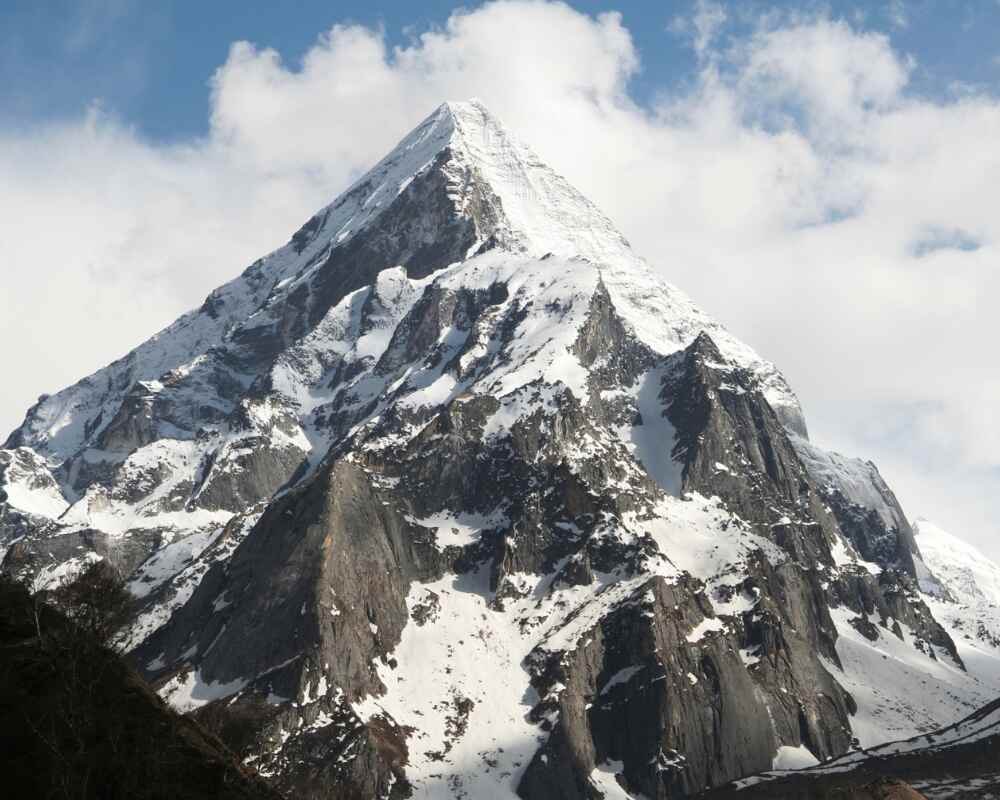
If someone asked you to name the single easiest way to legitimately summit a peak in Nepal, crampons and all, the honest answer is Yala Peak and it isn't close. Shortest approach. Lowest altitude of the three. Shortest technical section on summit morning. It's the mountain most experienced guides quietly steer first-timers toward, not because it's easy in any absolute sense, but because it lets you feel what peak climbing actually is without asking you to bet your first attempt on something that can go badly wrong.
Getting there doesn't even require flying. Yala sits in the Langtang region, about two hours by road from Kathmandu, which sidesteps one of the more common headaches in Nepal mountain travel the notoriously weather-dependent flights in and out of Lukla that can strand climbers for days. From the trailhead, you climb through the Langtang Valley itself, threading through villages and pine forest before the trees thin out and the mountain finally comes into full view.
Summit morning is where Yala earns its reputation. You'll strap on crampons for the snow and glacier crossing, but there's no fixed rope to wrestle with, no technical rock. The push from high camp to the top usually takes three to four hours. Your guide fits your crampons for you and walks you through using them before you even leave camp genuinely, no prior skill is assumed. You're learning in real time, on a mountain patient enough to let you.
So who's this actually for?
Someone who's done a multi-day trek before and shows up reasonably fit. That's it. No 5,000m experience required. No crampon history required. It's the mountain to climb if you want an honest answer to "do I actually enjoy this?" before you commit real time and money to something bigger.
The permit situation is a genuine bright spot here, too. Peaks under 5,800m, Yala included are exempt from the NMA's climbing royalty altogether, so there's no permit fee for the climb itself, just a TIMS card and a Langtang National Park entry fee, both minor. Outshine's Yala Peak package runs 15 days start to finish and comes in at US$1,375.
View our Yala Peak Climbing package.
2. Mera Peak (6,470m) — Higher, But Not Harder
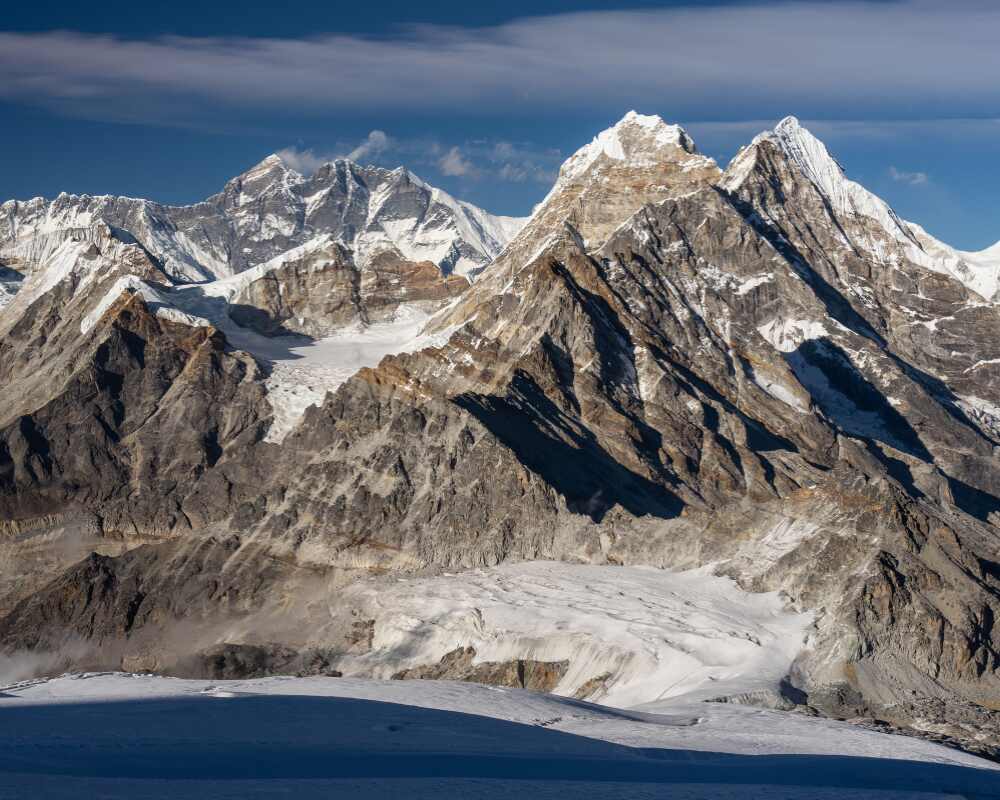
Here's the fact that trips people up every time: Mera Peak sits considerably higher than Island Peak, yet most guides who've climbed both will tell you Mera is the easier mountain. It sounds backwards until you understand what the two climbs actually demand. Mera, for all its altitude, is essentially one long, sustained glacier walk. No headwall. No rope-ascending technique. Just steady snow and ice underfoot on a route guiding companies have been running for decades.
The approach threads into the Hinku Valley, quieter and more remote than the well-trodden path to Everest Base Camp. Don't mistake "remote" for "primitive," though teahouses appear reliably once you climb higher, so you're not camping the whole way in. Summit day is the longest of the three peaks in pure endurance terms: crampons, ice axe, and five to six sustained hours from high camp to the top. What waits at the summit is arguably the best view available on any trekking peak in the country five separate 8,000m giants strung across the horizon, Everest among them, in a panorama that photos genuinely fail to capture.
Who should actually attempt this?
Mera rewards a particular kind of climber: someone who's already stood at Everest Base Camp, or Annapurna Base Camp, or somewhere equally demanding, and is now ready to cross the 6,000m threshold for real. This is less about technical finesse and more about whether your body handles sustained altitude well. Turning up with at least some prior crampon and ice axe time is worth the effort, even if your guide will train you properly regardless walking into a six-hour summit push having never worn crampons before is a needless extra weight to carry.
And here's where a fact-check actually matters: a lot of guides floating around online still quote the old NMA permit fees USD 250 for spring, USD 125 for autumn. Those numbers are out of date. The NMA overhauled its trekking-peak royalty structure in September 2025, and the current rate for the 2026/2027 season is USD 350 in spring and USD 175 in autumn. If a quote you've seen elsewhere still uses the old figures, that's your sign it hasn't been updated. Outshine's Mera Peak package runs 18 days and starts at US$2,050, permits included.
View our Mera Peak Climbing package.
3. Island Peak (6,160m) — Where "Beginner" Gets a Little Generous
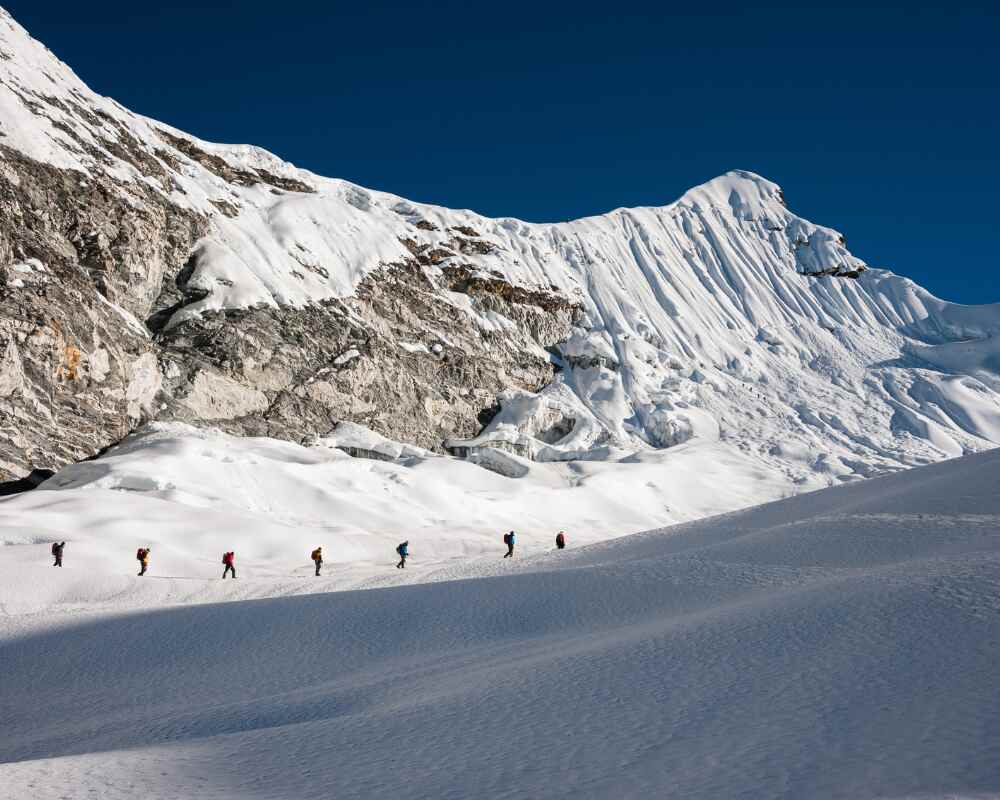
Let's be straight about this one, because a lot of marketing copy isn't: Island Peak gets called a beginner peak far more often than it earns the label. Of the three mountains here, it's the one that steps just past true beginner territory, and the reason has a name the headwall.
Near the summit, the route runs into a steep wall of fixed rope that requires jumar technique: clipping a mechanical ascender onto a fixed line and climbing it under your own strength. That's a genuinely different skill from anything Yala or Mera asks of you. It's not technical rock climbing, and you don't need a climbing background to learn it but it is a real, demanding section, and it punishes hesitation far more than it rewards raw fitness.
Island Peak sits in the Chhukung Valley, deep in the Everest region, reached along the same classic trail that runs through Namche Bazaar and Tengboche, so the infrastructure along the way is excellent even as the final approach turns remote. Summit day starts hours before dawn, so climbers reach the headwall while the snow is still frozen solid rather than softened by morning sun. That headwall is the crux of the entire climb steep, exposed, demanding real technique on top of hours of fatigue and thin air.
Who should actually attempt this?
Trekkers who've already banked Everest Base Camp or similar, and who've spent a day or two beforehand practicing with a harness, jumar, and fixed line rather than meeting that gear for the first time at 6,000m in the dark. Being fully honest: Island Peak is the hardest of the three peaks in this guide, and it shouldn't be sold to anyone as an easy first climb. It's a superb next step once you've tested yourself on Yala or Mera and want a genuine technical challenge just walk in with clear eyes about what the headwall demands of you.
Permit costs track Mera Peak under the same 2025 fee revision: USD 350 in spring, USD 175 in autumn for the 2026/2027 season. Outshine's Island Peak package runs 16 days and starts at US$1,900.
View our Island Peak Climbing package.
Still torn between Mera and Island Peak specifically? Our detailed Mera Peak vs Island Peak comparison breaks down the two head-to-head.
Beginner Peak Comparison Table
Side by side, the differences jump out fast.
Peak | Altitude | Region | Difficulty | Duration | Permit Cost (NMA, 2026/2027) | Price from |
| Yala Peak | 5,732m | Langtang | Beginner | 15 days | Free (royalty-exempt) | US$1,375 |
| Mera Peak | 6,470m | Everest | Beginner–Moderate | 18 days | USD 350 (spring) / USD 175 (autumn) | US$2,050 |
| Island Peak | 6,160m | Everest | Moderate | 16 days | USD 350 (spring) / USD 175 (autumn) | US$1,900 |
What Experience Do You Actually Need?
This is the question everyone asks before they book, and it deserves a genuinely honest answer rather than a reassuring one because the mountain doesn't care how confident you felt in the planning stage.
- Physical fitness is the real baseline, above everything else. All three peaks demand walking five to eight hours a day, for ten-plus consecutive days, on uneven ground at altitude. For Yala Peak, prior trekking experience above 3,500m helps but genuinely isn't mandatory the mountain is forgiving enough that a fit first-timer can succeed without it. For Mera and Island Peak, that leniency disappears. Having already completed EBC, Annapurna Base Camp, or something comparable is strongly recommended, because those treks are how you learn how your own body responds to sustained altitude before you gamble on something higher.
- Technical skill follows a similar curve. For Yala, honestly, none is required your guide fits and demonstrates crampon use on the spot, and the terrain is gentle enough to learn as you go. For Mera and Island Peak, arriving with some prior crampon and ice axe practice is worth the effort, even though your guide trains you regardless once you're there. And for Island Peak specifically, a little familiarity with a harness and jumar beforehand can be the difference between working through the headwall with confidence and fumbling unfamiliar gear at 6,000m in the pre-dawn cold.
- Altitude experience, surprisingly, isn't a hard requirement for any of the three you could, on paper, go straight from sea level to a 6,000m summit push. But "not required" and "wise to have" are very different things. Prior altitude exposure meaningfully raises your odds of actually reaching the top. And here's the detail that catches most people off guard: across all three peaks, the number one reason summit attempts fail isn't technical difficulty at all. It's altitude sickness. The thing that beats most climbers isn't a rope or a headwall it's simply the air.
When Is the Best Time to Climb?
Spring (March to May) and autumn (September to November) are the two seasons worth building a trip around, on all three peaks. Both bring more stable weather, firmer snow underfoot on summit day which matters enormously for crampon grip and calmer wind than the shoulder months. One wrinkle worth knowing: under the 2025 permit revision, spring now carries the higher NMA fee for both Mera and Island Peak, while autumn is noticeably cheaper on that line alone. Despite the price gap, plenty of experienced climbers still lean toward spring, largely because the weather windows heading into the pre-monsoon period tend to hold slightly more reliably for a successful summit push.
Do I Need to Hire a Guide?
Yes, and this one isn't a matter of personal choice. Nepal's 2023 trekking regulations require every foreign national to climb with a licensed guide on all classified trekking peaks Yala, Mera, and Island included. Solo, unguided climbing simply isn't permitted, regardless of how experienced you are. Every Outshine Adventure package includes a licensed high-altitude guide as standard.
Ready to Climb? View All Peak Climbing Packages
For the full lineup of all six trekking peak packages Outshine Adventure offers including Lobuche Peak, Pisang Peak, and the Mera Above Base Camp short package visit our peak climbing in Nepal page. Our guides are on hand to help you match the right peak to your experience and fitness level.
.webp)