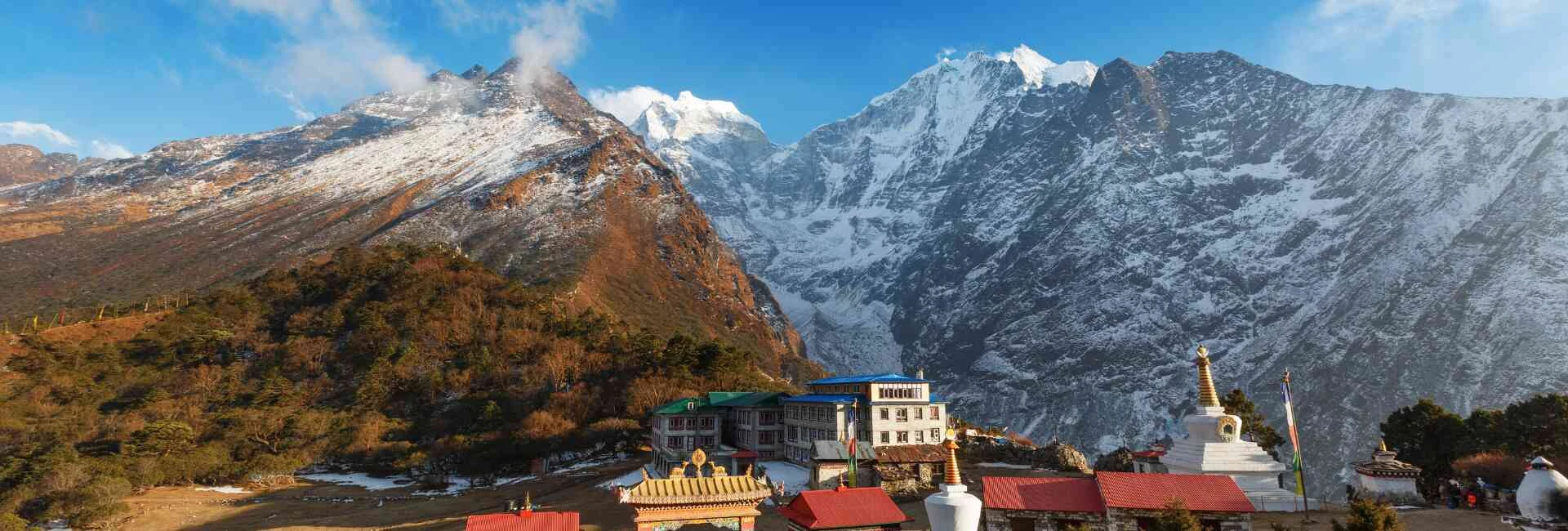
Quick Facts About Tengboche
Here's the essential information at a glance before we go deep:
- Elevation: 3,867 meters (12,687 feet)
- Location: Khumbu region, Sagarmatha National Park, Nepal
- Full name: Tengboche Monastery, also called Dawa Choling Gompa
- Sect: Nyingma school of Tibetan Buddhism
- Founded: 1916, by Lama Gulu
- Rebuilt: After a 1934 earthquake and again after a devastating 1989 fire
- Distance from Namche Bazaar: Roughly 10 kilometers (about 5 to 6 hours of walking)
- Distance from Lukla: Around 3 to 4 days of trekking, depending on itinerary
- Best known for: Panoramic views of Everest, Lhotse, Nuptse, and Ama Dablam, plus the annual Mani Rimdu festival
- Typical overnight stop: Yes, most itineraries include a night in Tengboche for acclimatization and the sunset/sunrise views
If you ask trekkers on the Everest Base Camp trail where they got their single best photo of the mountain, an enormous number of them will point to the same spot: the courtyard in front of Tengboche Monastery. You come around a final bend in the trail, the forest opens up, and there it is: a wide grassy plateau, a whitewashed monastery with a golden roof, and behind it, filling the entire sky, Everest, Lhotse, Nuptse and Ama Dablam standing shoulder to shoulder.
This guide is about exactly why that view earns its reputation, and everything you need to know to see it properly for yourself in 2026: the monastery behind the view, the trail logic between Namche Bazaar and Tengboche (spoiler: it is not a straight climb), the best timing and conditions for catching Everest at its clearest, and the Mani Rimdu festival that occasionally overlaps with a visit here.
Why Tengboche Has the Best Everest View on the Trail
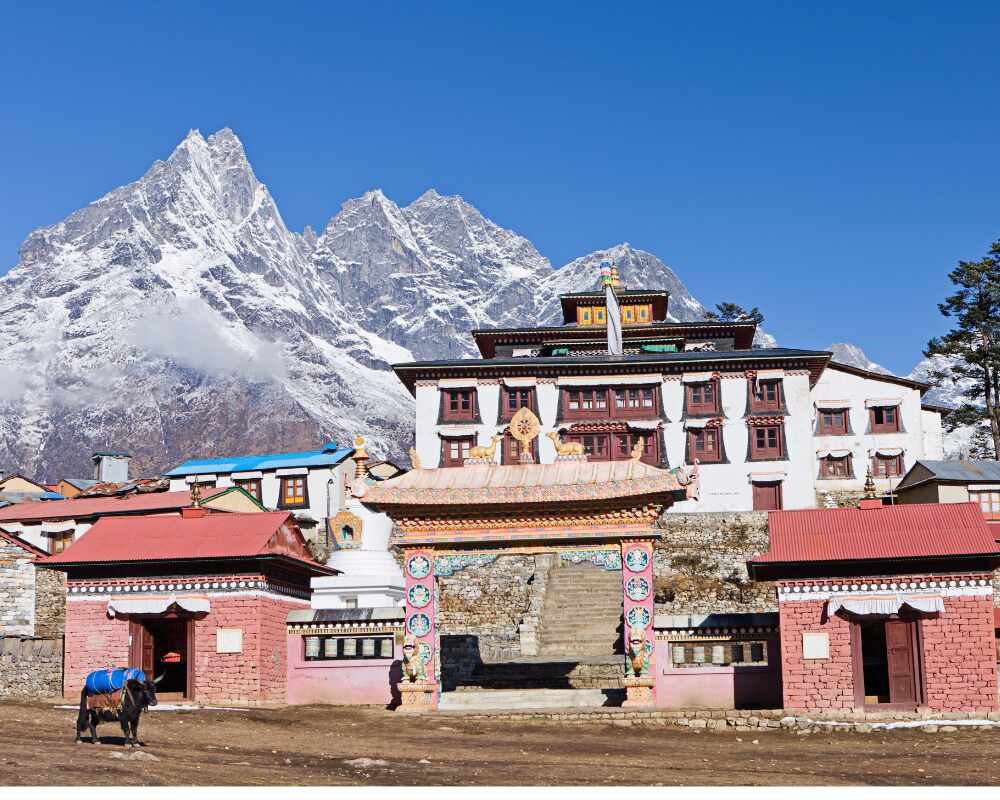
Plenty of points along the Everest Base Camp route offer mountain views. What makes Tengboche's view the one people keep coming back to is a specific combination of factors, not just the altitude.
A few reasons this exact spot earns the title:
- It's the first place on the trek where Everest, Lhotse, Nuptse, and Ama Dablam all appear together in one unobstructed frame, rather than glimpsed individually from different angles.
- The monastery courtyard sits at the exact point on the trail where the mountains stop being distant and start being immediate. You've seen Everest from Namche already, small and far off. From Tengboche's courtyard, the same mountain feels close enough to touch.
- Unlike higher, more remote viewpoints such as Kala Patthar, this view is reachable early in the trek, at a comfortable elevation, without requiring a dedicated side excursion or heavy acclimatization.
- The golden monastery roof in the foreground gives the view a composition that pure mountain panoramas elsewhere on the trail don't have, which is part of why it's the single most photographed spot on the lower half of the route.
For trekkers, Tengboche is rarely just a checkpoint. It's the moment the trip stops feeling like a hike toward distant mountains and starts feeling like you've actually arrived among them.
Why Tengboche Is Called the Everest Trek's Spiritual Heart
Every long trek needs a center of gravity, a place where the physical journey and something deeper meet. On the Everest Base Camp trail, that place is Tengboche.
A few reasons this village earns the title:
- It hosts the largest and most important monastery in the Khumbu region, home to an active community of monks who have lived and practiced there for over a century.
- It sits at the exact point on the trail where the mountains stop being distant and start being immediate. You've seen Everest from Namche already, small and far off. From Tengboche's courtyard, the same mountain feels close enough to touch.
- Sherpa mountaineers and expedition teams have historically stopped here to receive blessings before attempting Everest, a tradition that continues today.
- The monastery has survived earthquake, fire, and geopolitical upheaval, and its rebuilding each time says something about the resilience of Sherpa Buddhist culture in this valley.
For trekkers, Tengboche is rarely just a checkpoint. It tends to be the moment the trip stops feeling like a hike and starts feeling like a pilgrimage, whether or not you arrived with that intention.
The History of Tengboche Monastery
Founding and Early Years
Tengboche Monastery was founded in 1916 by Lama Gulu, a respected spiritual figure in the region. According to local tradition, Lama Gulu chose the site after being guided by visions and by the recommendation of Rongbuk Monastery in Tibet, which had close spiritual ties to the Khumbu Sherpa community across the border.
The site itself was already considered sacred. Local folklore holds that Guru Rinpoche (Padmasambhava), the eighth-century figure credited with bringing Buddhism to the Himalayan region, once rested at this exact spot on his way to Tibet.
Destruction and Rebuilding
Tengboche has been rebuilt not once, but twice:
- The 1934 earthquake. A massive earthquake centered in Nepal and Bihar caused significant structural damage to the monastery. It was repaired and reconstructed with support from the local community.
- The 1989 fire. This was the more devastating event. A fire, believed to have started from an electrical short circuit, burned the monastery to the ground, destroying centuries-old manuscripts, statues, and murals. The Sherpa community, along with international donors and mountaineering organizations that had long benefited from the monastery's blessings, funded a full reconstruction. The monastery reopened in the early 1990s, rebuilt with the same layout and much of the same symbolic detail as before, though naturally some historical artifacts were lost forever.
This cycle of destruction and rebuilding is part of why Tengboche carries such weight in the region. It is not a museum piece. It is a living institution that the community has repeatedly chosen to restore.
Tengboche and Everest Expeditions
Tengboche has a long, documented relationship with Everest mountaineering history. Early expedition teams, including members of the 1953 British expedition that put Edmund Hillary and Tenzing Norgay on the summit, passed through and interacted with the monastery. To this day, many expedition teams still visit Tengboche before heading up toward Base Camp to receive a puja, a blessing ceremony intended to ask the mountain deities for safe passage.
If you are trekking during expedition season (roughly March through May), there's a good chance you'll see mountaineers and their Sherpa crews doing exactly this.
The View From Tengboche's Courtyard
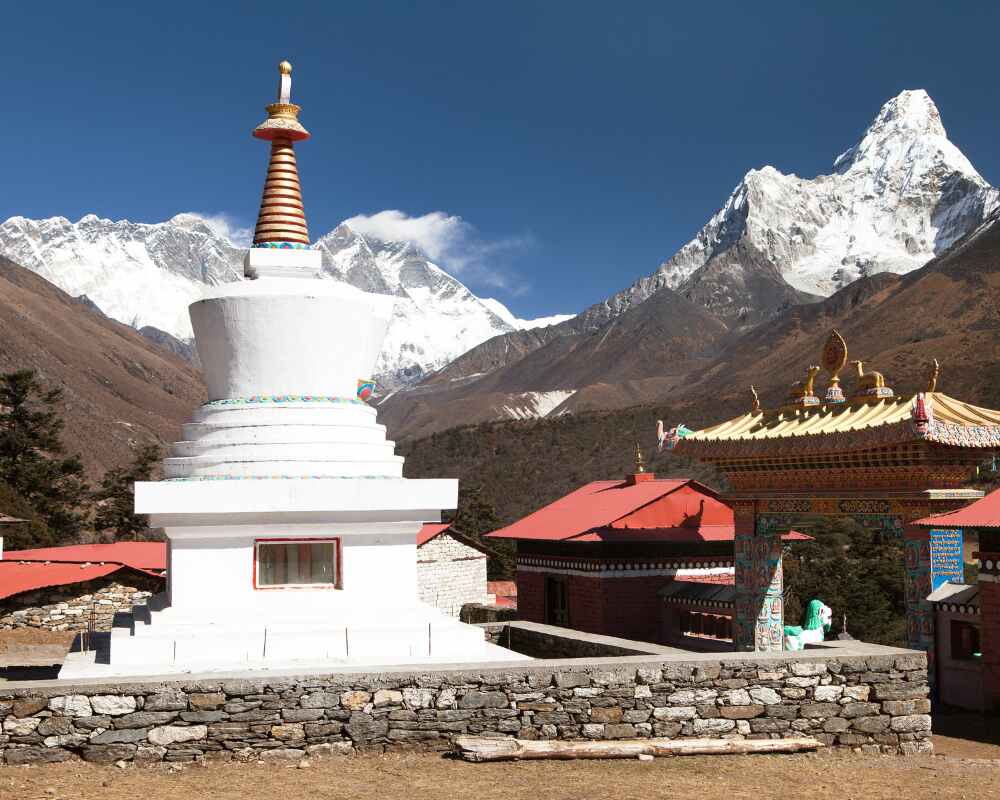
This is the part people actually come for, if we're honest, and it does not disappoint.
Standing in the open courtyard in front of the monastery, on a clear day, you get a direct, unobstructed view of some of the most famous peaks on Earth:
- Mount Everest (8,849 m), peeking up behind the Nuptse-Lhotse wall
- Lhotse (8,516 m), the fourth-highest mountain in the world
- Nuptse (7,861 m), forming a dramatic wall in the foreground
- Ama Dablam (6,812 m), arguably the most photogenic mountain in the entire Khumbu, often compared to the Matterhorn for its sharp, symmetrical shape
- Thamserku and Kantega, rounding out the panorama to the east
A few tips for actually experiencing this view at its best:
- Early morning is generally the clearest window, before afternoon clouds tend to build up and obscure the higher peaks.
- Sunset is when Everest's summit pyramid often catches the last light in a pink or golden glow, a phenomenon trekkers commonly call "alpenglow."
- Bring a proper camera or at least a phone with a wide-angle option. This is one of the few spots on the trek where a single frame can capture four separate 6,000+ meter peaks.
- If it's cloudy when you arrive, don't panic. Weather patterns in the Khumbu often clear up by early evening or the following morning, and many guides deliberately schedule the overnight stop in Tengboche partly for this reason.
Mani Rimdu Festival: Tengboche's Biggest Celebration
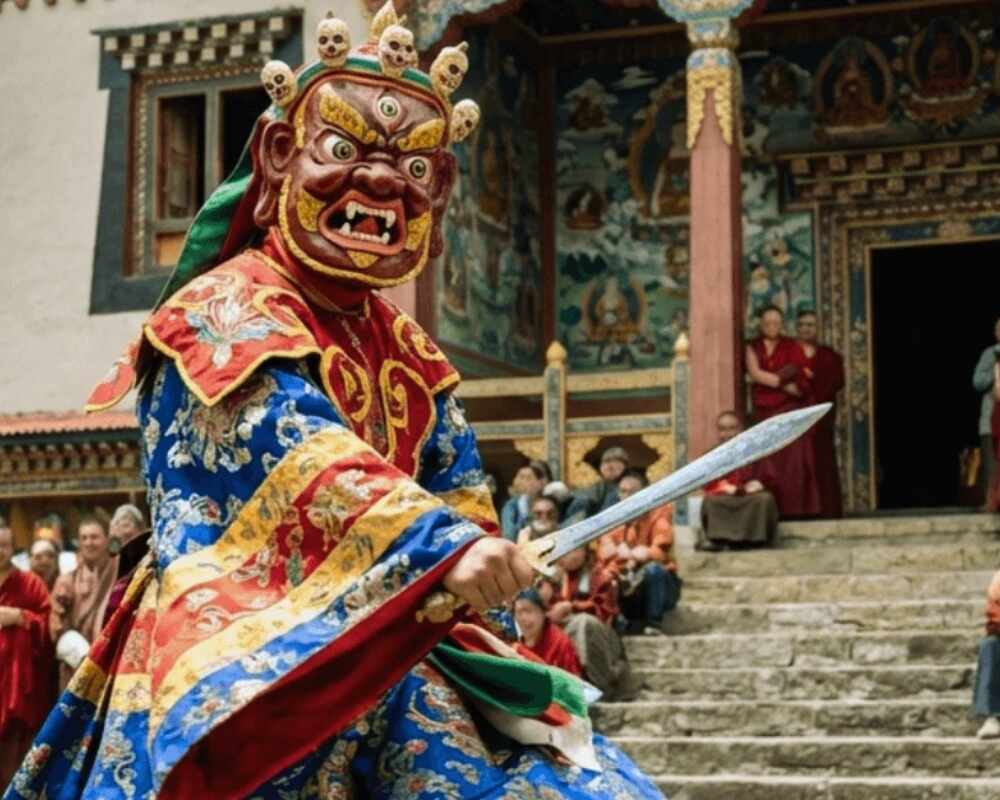
If your Everest trek timing overlaps with autumn, specifically October or November, you may have the chance to witness one of the most significant Buddhist festivals in the entire Himalayan region: Mani Rimdu.
What Mani Rimdu Actually Is and Why Timing Matters
Mani Rimdu is a multi-day festival held at Tengboche (and at a few other monasteries in the region, including Thami and Chiwong, though on different dates) that combines:
- Elaborate masked dances, performed by monks in ornate costumes representing deities, protectors, and demons, portraying the triumph of Buddhism over hostile forces
- Sand mandala creation, an intricate, painstaking art form where monks spend days constructing a detailed mandala from colored sand, only to ritually destroy it afterward as a teaching on impermanence
- Public blessings, where the head lama distributes blessed items to attendees
- Sacred fire ceremonies and chanting sessions that run for hours
Mani Rimdu follows the Tibetan lunar calendar, which means the exact dates shift slightly from year to year rather than falling on a fixed date. If you want to plan your 2026 Everest trek around this festival specifically, a few notes:
- Dates are typically confirmed closer to the season itself, so check with a local trekking operator or the monastery for the confirmed 2026 dates before locking in flights.
- The festival usually spans three days, with the masked dances (the most visually dramatic part) typically happening on the middle day.
- Tengboche gets significantly busier during the festival period. If you're planning to attend, book accommodation well in advance, since teahouse rooms fill up fast.
- Even if you can't time your trek exactly to the festival, visiting Tengboche any time in the days just before or after often means encountering monks in preparation mode, rehearsing dances or working on festival preparations, which is its own kind of memorable experience.
We've covered Mani Rimdu in much more depth, including a full breakdown of the ceremony schedule and what to expect day by day, in a separate guide. If you'd rather combine the festival directly into your Base Camp itinerary, it's also possible to trek the Everest Base Camp route with the Mani Rimdu Festival built into the schedule.
Practical Information for Visiting Tengboche
Accommodation
Tengboche has a small cluster of teahouses, considerably fewer than a hub like Namche Bazaar, so a few practical notes:
- Rooms are simple: twin beds, shared bathrooms in most cases, thick blankets provided (though bringing your own sleeping bag is still strongly recommended).
- During peak season (spring and autumn), rooms can fill up by early afternoon, so arriving with enough daylight left is wise.
- Dining rooms tend to double as the social and warmth hub in the evening, usually centered around a wood or yak-dung stove.
Food and Water
- Standard teahouse menus apply: dal bhat (the trekker's staple), noodle soups, fried rice, momos, and various pancake/porridge options for breakfast.
- Prices increase gradually the higher you climb, reflecting the cost of portering supplies up the trail.
- Bring a water purification method (filter, tablets, or a UV sterilizer) rather than relying solely on bottled water, both for cost and environmental reasons.
Best Time to Visit
- Spring (March to May): Rhododendrons in bloom, generally stable weather, and this is peak expedition season, so more mountaineering activity and puja ceremonies to witness.
- Autumn (late September to November): The clearest skies of the year for mountain views, plus the possibility of catching Mani Rimdu.
- Winter (December to February): Fewer crowds and crisp, clear air, but significantly colder, with some teahouses closing.
- Monsoon (June to August): Generally not recommended due to persistent cloud cover, leech-heavy lower trails, and obscured mountain views, which somewhat defeats the point of the trip.
Altitude Considerations
Tengboche sits at 3,867 meters, which is high enough that altitude awareness matters:
- Most itineraries schedule an overnight in Tengboche as part of a gradual ascent profile, which also happens to be one of the best places on the trek to rest given the views.
- Watch for early symptoms of altitude sickness: headache, nausea, unusual fatigue, or disrupted sleep. Mild symptoms are common and usually manageable, but worsening symptoms mean it's time to stop ascending or descend.
- Staying well hydrated and avoiding alcohol at this elevation makes a genuine difference in how you feel the next morning.
What to Pack Specifically for This Stretch
- Warm layers for the evening. Tengboche gets notably cold after sunset, even in the warmer trekking seasons.
- A headlamp, since early morning prayer sessions and sunrise viewing both happen before full daylight.
- A camera with spare batteries. Cold temperatures drain battery life faster than usual, and this is not a place you want to run out of charge.
- Modest clothing for the monastery visit itself, even if you're otherwise in trekking gear.
Cultural Significance of Sherpa Buddhism in the Khumbu
To understand why Tengboche matters so much to the region, it helps to understand a bit about the broader religious and cultural context of the Khumbu.
- Sherpa identity and Buddhism are deeply intertwined. The Sherpa people migrated from eastern Tibet centuries ago, bringing Nyingma Buddhist practice with them, and that tradition has shaped nearly every aspect of daily and ceremonial life in the region since.
- Monasteries function as community anchors, not just religious buildings. Tengboche, like other gompas in the region, has historically played a role in education, dispute resolution, and community organizing, beyond its purely spiritual functions.
- Mountains themselves are considered sacred. Many peaks in the region, including Everest (known locally as Chomolungma, "Goddess Mother of the World"), are regarded as the dwelling places of protective deities. This is part of why expedition pujas are taken so seriously by Sherpa mountaineering crews, regardless of a foreign client's own beliefs.
- The relationship between trekking tourism and monastic life is a careful balance. Tengboche has had to adapt to a huge increase in foot traffic since the 1950s, while trying to preserve an authentic, functioning religious practice rather than becoming a staged tourist attraction. Visitors who approach the monastery with genuine respect and curiosity help sustain that balance.
Tengboche is one stop in a much longer journey, and it's worth seeing it in that broader context. If you're still mapping out your full route, our Everest Base Camp Trek guide covers the entire itinerary from Lukla to Base Camp and back, including altitude profiles, day-by-day breakdowns, and gear recommendations for the whole trip.
For a deeper planning resource that ties together permits, training advice, seasonal considerations, and logistics across the whole region, our Complete Guide is the best starting point before you book anything.
Frequently Asked Questions About Tengboche
Is Tengboche Monastery open to non-Buddhist visitors? Yes. The monastery welcomes visitors of all backgrounds, both during regular prayer sessions and for general viewing, as long as basic etiquette (removing hats, staying quiet, asking before photographing) is respected.
Do I need a guide to visit Tengboche? Not strictly, since it sits directly on the main Everest Base Camp trail, but a guide can add significant value here by explaining the history, symbolism of the murals, and current happenings at the monastery that you'd otherwise miss. See our breakdown of Nepal's current guide and permit rules for the latest requirements.
How cold does it get in Tengboche? Nighttime temperatures can drop well below freezing even in the main trekking seasons, particularly in the shoulder months. Layering and a good sleeping bag rated for cold temperatures are essential.
Can I stay overnight inside the monastery itself? No, the monastery is a working religious institution, not accommodation. Trekkers stay in the nearby teahouses in Tengboche village, a short walk from the monastery grounds.
Is the Everest view from Tengboche better than from other points on the trail? It's different rather than strictly better. Kala Patthar offers a much closer, more dramatic view near Base Camp itself, but Tengboche is unique for combining the mountain panorama with the monastery courtyard setting, arguably making it the most photogenic single viewpoint on the lower half of the trek.
How long should I spend in Tengboche? At minimum, one overnight stay to catch both sunset and sunrise views. Some itineraries build in a second night as a dedicated acclimatization day, especially if the weather on arrival was cloudy and a repeat attempt at the view is worthwhile.
Is there mobile signal or Wi-Fi in Tengboche? Limited mobile coverage exists in parts of the Khumbu, and some teahouses offer paid Wi-Fi, though speeds are slow and connections unreliable. Don't count on a strong connection here.
What should I wear inside the monastery? Modest, fully covering clothing. Long trousers or leggings rather than shorts, and shoulders covered. A warm layer works well anyway, since the interior isn't heated.
Can children or older trekkers manage the Namche to Tengboche stretch? It's a moderately demanding day due to the descent-then-climb profile, but it's regularly completed by a wide range of ages and fitness levels, provided the pace is kept slow and steady, particularly on the final climb. Our guide to easy treks in Nepal for beginners covers how guides help manage pace for less experienced trekkers more broadly.
Final Thoughts
Tengboche earns its reputation the honest way, through a combination of history, an active living community, and a view that genuinely stops people in their tracks. It's not a detour or a side trip on the way to Everest Base Camp. It's arguably the emotional midpoint of the entire trek, the place where the mountains stop being a distant idea and start becoming the thing standing directly in front of you.
Whether you time your trip for Mani Rimdu, catch a mountaineering team receiving a puja before their summit attempt, or simply arrive tired from the Phunki Thanga climb and get rewarded with a clear sunset over Ama Dablam, Tengboche tends to be the stop trekkers talk about most once they're back home.
Plan for it. Give yourself the extra time. It's worth every step of that unexpected descent and climb.
That's exactly the kind of experience Outshine Adventure builds its Everest itineraries around: enough time at the right places, like Tengboche, so the trek isn't just about reaching Base Camp, but about actually being present for the moments that make the journey worth it. If you're planning your own trip to see this view for yourself, our team at Outshine Adventure can help you build an itinerary that gives Tengboche the time it deserves.