.webp)
Every Everest Base Camp trek has an official day one on paper. Ask trekkers when the trip actually started for them, though, and most won't say Phakding or Namche. They'll say the plane.
That's not an accident of memory. Everything about the Kathmandu–Lukla flight is built to feel like a threshold: a small aircraft, a runway carved into a mountainside, and roughly half an hour that takes you from a crowded capital to a village where the trail simply begins outside the terminal. The days before it (permits, gear checks, meeting your guide) are preparation. Lukla is where the trip actually starts.
Why this flight, specifically, feels like the start
Nothing before it does. The days in Kathmandu, sorting permits, meeting your guide, a last look at your packing list, are preparation. Lukla is arrival. One trekker's account of the flight put it simply: the adventure didn't start with a footstep on the trail, it started at the airport in Kathmandu, the night before, lying awake.
Part of that is the terrain doing the work for you. Within minutes of takeoff, Kathmandu's rooftops give way to terraced hillsides, then river gorges, then the ridgelines of the Khumbu, and the geography changes faster than it does on any single day of walking. Part of it is the landing itself, and part of it is simpler than that: it's the first moment the trip stops being a plan and starts being a place. On the ground, that shift is often marked literally. A small ritual travel writers keep noting is passengers breaking into applause the moment the wheels touch down, a mix of relief and the recognition that the trek has actually begun.
Everything below is really about protecting that moment, making sure the flight that starts your trek doesn't also derail it.
What the flight actually involves
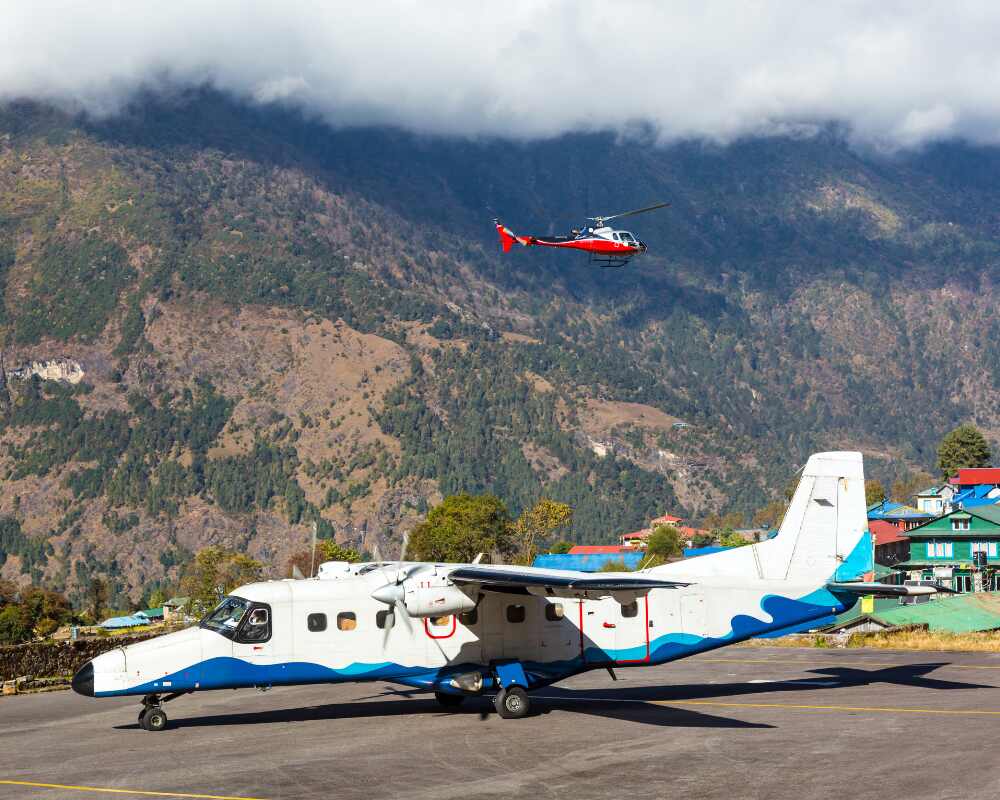
The basics. It's a short hop, about 30–35 minutes from Kathmandu's Tribhuvan International Airport, or roughly 15–20 minutes if you're flying from Manthali Airport in Ramechhap during peak season (more on that below). You'll be on a small twin-engine aircraft, usually a Twin Otter or Dornier 228, carrying 16–19 passengers, operated by one of a handful of Nepali carriers running the route: Tara Air, Summit Air, and Shree Airlines among them.
Boarding. There's no jetway and no boarding call over a PA system. You walk out across the tarmac, hand your bag over for weighing (baggage limits here are tight, budget on roughly 15 kg checked and 5 kg hand luggage, though it varies slightly by airline and route), and climb a short set of stairs into a single-aisle cabin.
The flight. Once you're airborne, the geography does most of the talking: green hills near Kathmandu, then deep river valleys, then your first real look at the snow-capped Himalayan skyline. It's often described as one of the most scenic short flights anywhere in the world, which tends to get lost in all the talk about the landing.
Who's flying you. These aren't general commercial pilots rotated onto the route. Nepal's civil aviation regulator requires a season of supervised mountain flying and a set number of certified missions before a pilot can fly this route independently. It's treated as its own specialty within Nepali aviation.
The landing, and whether the "world's most dangerous airport" label is fair
This is what almost everyone searching about Lukla is really asking, so it's worth answering directly.
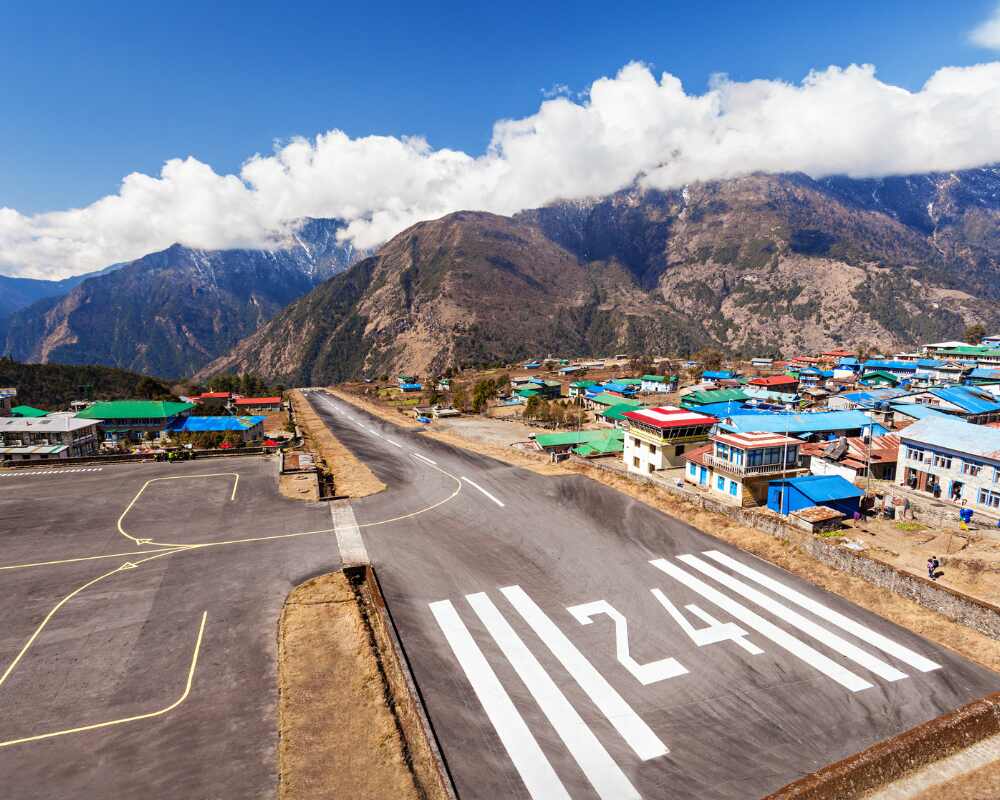
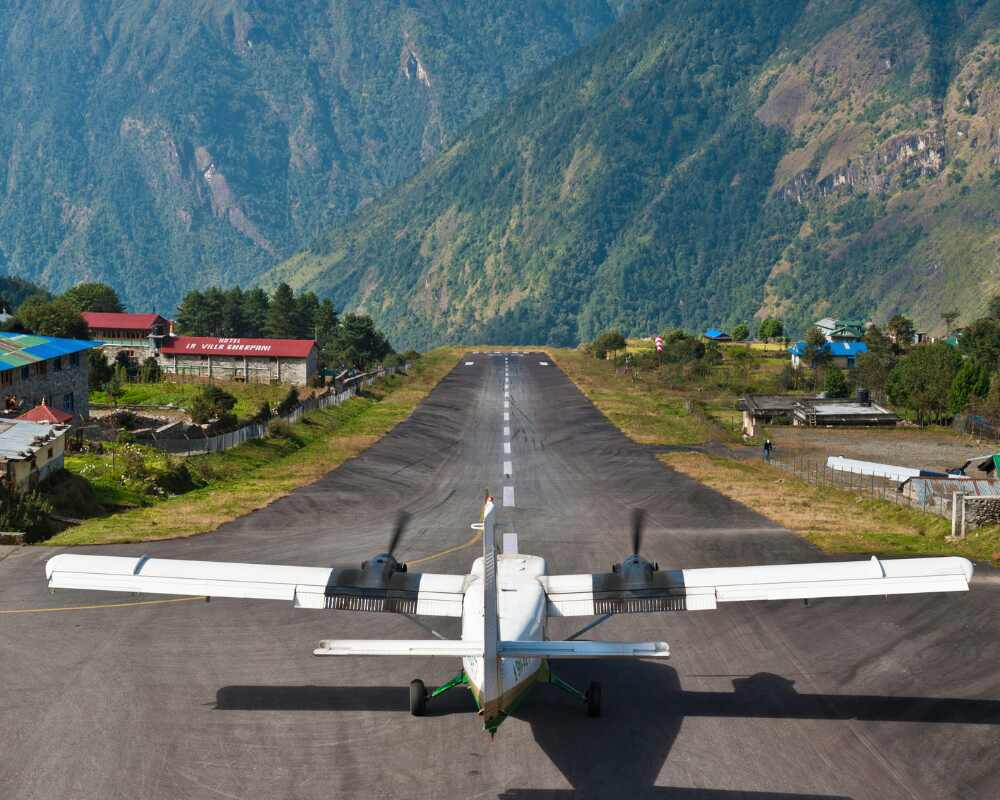
What's true:Tenzing-Hillary Airport sits at 2,845 m, with a single runway just 527 meters long, a fraction of a normal commercial runway, sloped uphill at roughly 12%, with a mountain wall at one end and a drop into the valley at the other. There's no radar and no instrument landing system; every approach is flown visually, and once a plane commits to landing, there's essentially no going around. As a Tara Air pilot told Gulf News after years of flying the route, once you cross the river on final approach, there's no turning back; you have to land. Those are the physical facts behind the "most dangerous airport" headlines, and they're genuinely unusual.
What tends to get skipped: those exact constraints are why the system around this airport is built with unusually wide safety margins. Flights don't push through marginal weather; they simply don't go, and get rescheduled instead. Pilots are certified specifically for this strip, not for mountain flying in general. The airport does have a documented accident history (the most serious was a 2008 crash on final approach in deteriorating weather), and each serious incident over the decades has led to tighter protocol rather than being written off. The honest summary isn't "it's totally safe" or "it's the most dangerous airport in the world." It's that this is a demanding environment flown by specialists, under rules built specifically because the terrain leaves so little margin for error. The label generates clicks; the reality is closer to "extremely disciplined about a hard problem."
This is the part that actually matters for your itinerary, more than the safety question, statistically, because delays are common and accidents are not.
Why Do Flights to Lukla Get Cancelled?
This is the part that actually matters for your itinerary, more than the safety question, statistically, because delays are common and accidents are not.
Weather, specifically visibility and wind, is the entire story. Because Lukla operates under visual flight rules with no instrument landing system, pilots need a clear sightline to the runway on approach. There's no fallback for flying through cloud on instruments the way a commercial jet would at a major airport. If cloud, fog, or haze sits over the strip, flights don't go: not delayed by a few minutes, but held until conditions clear or the day's flying window closes.
The seasonal pattern
- Morning fog (November through January): builds overnight in the valley and normally burns off by mid-to-late morning. This is the delay type that catches trekkers most off guard, because the sky can look completely clear in Kathmandu at the pre-dawn hour when you leave for the airport, while Lukla itself is still socked in.
- Cloud buildup (spring and pre-monsoon months): convective cloud can arrive earlier in the day than forecast. Flights are scheduled early specifically to get ahead of afternoon cloud, and when that cloud shows up ahead of schedule, later departures cancel in sequence.
- Wind: particularly the crosswind that develops as wind direction shifts from northeast to southwest through the morning, closing the airport even on days that otherwise look flyable from Kathmandu.
- Monsoon season (roughly late May through early September): brings the highest and most unpredictable disruption of the year, part of why it's not peak trekking season to begin with.
Why one bad morning becomes a multi-day problem
Capacity is fixed and small. On a busy October morning, dozens of flights are trying to move hundreds of trekkers in both directions through a narrow weather window before afternoon cloud shuts things down. When that morning's flights are grounded, the backlog compounds, because it's not only your flight that's stacked up; it's every flight scheduled that day and the next, all competing for the same limited number of daylight hours and available seats.
A single foggy morning during peak season can realistically mean a two-day queue before the schedule catches up. Severe multi-day weather events have, in the past, stranded thousands of trekkers at once. An extreme example from Nepal's aviation history saw more than 2,000 tourists stranded at Lukla for roughly six days during one prolonged closure, with military helicopters eventually brought in to move people out in batches
What a delay actually looks like
A few hours, not a few days: a flight that doesn't show on schedule, a wait in the departure lounge or a Lukla teahouse, and either a same-day departure once weather clears or a seat on the next morning's flight. You're never stranded in any real sense: both ends of the route have food, accommodation, and usually power and wifi. The rare, headline version (a multi-day closure with a real backlog) does happen, but it's the exception, not the baseline. It's also the reason a serious itinerary doesn't assume the flight will simply go as scheduled.
The practical cost of even a short delay is rarely the waiting itself. It's what the waiting eats into: the acclimatization days built around Namche Bazaar and Dingboche, time at Base Camp, or a tightly booked flight home. That's the risk actually worth planning for.
The helicopter option
Once cancellations pile up, demand for helicopter seats rises quickly. People start asking about them in hotel lobbies, trekking agency offices, and airport waiting areas, and shared or "join-group" helicopter seats become the default backup once fixed-wing flights have been grounded for a day or more. Helicopters can sometimes fly in marginal conditions that ground the fixed-wing STOL aircraft, though they're still weather-limited and not a guaranteed fix during the worst closures.
Pricing varies significantly by route and whether you're booking a shared seat or a private charter: shared Kathmandu–Lukla seats typically run several hundred dollars per person, with private charters considerably higher. Confirm current pricing with your operator rather than relying on older quotes; it shifts with season and demand.
What Disruption Actually Costs You
This is the part that turns a weather delay into a real financial and logistical problem if you haven't planned for it:
- Missed international connections: if your homeward Lukla flight is delayed by two or three days and you booked a tight connection out of Kathmandu, you may need to rebook an international flight, often at short notice and at a much higher fare than your original ticket.
- Helicopter costs: typically not included in standard trek packages and usually excluded from travel insurance unless you've specifically bought a policy that covers weather-related trip interruption and emergency transport.
- Lodge and logistics costs while stranded: extra nights, meals, and in some cases porter or guide day-rates if your itinerary extends beyond what was originally budgeted.
- Lost trekking days: if the delay happens at the start of your trip rather than the end, a multi-day hold in Kathmandu before you've even flown in can compress the itinerary that follows, exactly the scenario a well-built buffer schedule is designed to prevent.
Good travel insurance for this trek should specifically include trip interruption, flight delay coverage, and emergency helicopter evacuation for mountain regions above standard altitude limits, not just generic trip cancellation. It's worth checking the fine print rather than assuming a standard policy covers Lukla-specific disruption.
For a full breakdown of what the flight, permits, and disruption contingencies add up to, see our Everest Base Camp Trek Cost Guide
The Ramechhap workaround
During the two peak trekking windows, spring and autumn, Lukla flights are typically flown out of Manthali Airport in Ramechhap district instead of Kathmandu, a change Nepal's aviation authorities put in place to ease the Kathmandu bottleneck described above. Ramechhap sits lower and quieter, with no international traffic competing for runway slots and a longer morning weather window, which in practice makes it the more reliable option during exactly the weeks Kathmandu is most congested.
The catch is entirely on the ground: reaching Ramechhap means an early-morning drive of several hours from Kathmandu, on a basic road, to a fairly basic airport. It's an inconvenient start to trek day one, but by most accounts, a more dependable one. Outside peak season, flights generally run directly out of Kathmandu instead. This routing has shifted more than once over the years depending on the season and government decision, so it's the kind of detail worth confirming with your operator close to your travel dates rather than assuming from an old blog post.
Best Time to Fly, and What to Pack for a Delay
Time of day
Book the earliest available flight, always. Morning departures have consistently better odds of clear conditions at both ends; afternoon slots carry meaningfully higher cancellation rates as cloud builds through the day. If you have any choice in the matter, don't schedule anything time-sensitive, including your international departure, for the same day as your return flight from Lukla.
Time of year
- Spring (March–May) and autumn (September–November): the most stable weather overall, which is exactly why they're peak trekking season, but also the highest passenger volume and the worst backlog effect when disruption does hit
- Winter (December–February): clearer skies on average, but colder mornings and more fog risk
- Monsoon season (June–August): the least reliable flying conditions of the year, not recommended for this trek regardless of flight logistics, given trail conditions
For official seasonal travel guidance and current entry requirements for Nepal, the Nepal Tourism Board, the country's national tourism authority, is the most reliable government-backed source.
What to actually pack, assuming a delay
- A day or two of buffer clothing beyond what you'd need for the trek itself
- Any regular medication in your carry bag rather than checked luggage
- A physical charger for your phone and a portable battery
- Enough patience and cash on hand to sit in Lukla or Kathmandu for an extra day or two without it derailing your mood, genuinely useful advice from repeat trekkers. This is normal. It is not a sign your trip is going badly.
Choosing an operator
Ask directly how a trekking company handles Lukla delays before you book:
- Do they build buffer days into the standard itinerary, or is that an optional add-on?
- Do they have standing relationships with airlines that speed up rebooking during a backlog, or will you be queuing independently?
- Does their trip cost include contingency planning, or does every delay become an unplanned expense?
The answer tells you a lot about how the rest of the trek will be run.
How we plan around all of this
We build every Everest Base Camp itinerary & cost with a buffer day near the start specifically to absorb a Lukla delay without eating into acclimatization or Base Camp time. If a delay runs longer than that, we coordinate directly with airlines and, when needed, arrange a helicopter option to make up lost time, a cost that sits outside the standard package price and is usually best covered through proper trekking travel insurance. We also never build an itinerary around a same-day international connection at either end of the trip, and we plan for Ramechhap by default whenever the season calls for it, rather than treating it as a surprise.
If you're weighing trekking styles and want to see how flight logistics factor into overall cost, our Everest Base Camp Trek Cost 2026–2027 guide breaks down exactly where the Lukla flight sits in the total budget across budget, standard, and luxury trek styles.
Arriving in Lukla: First Steps of the Trek
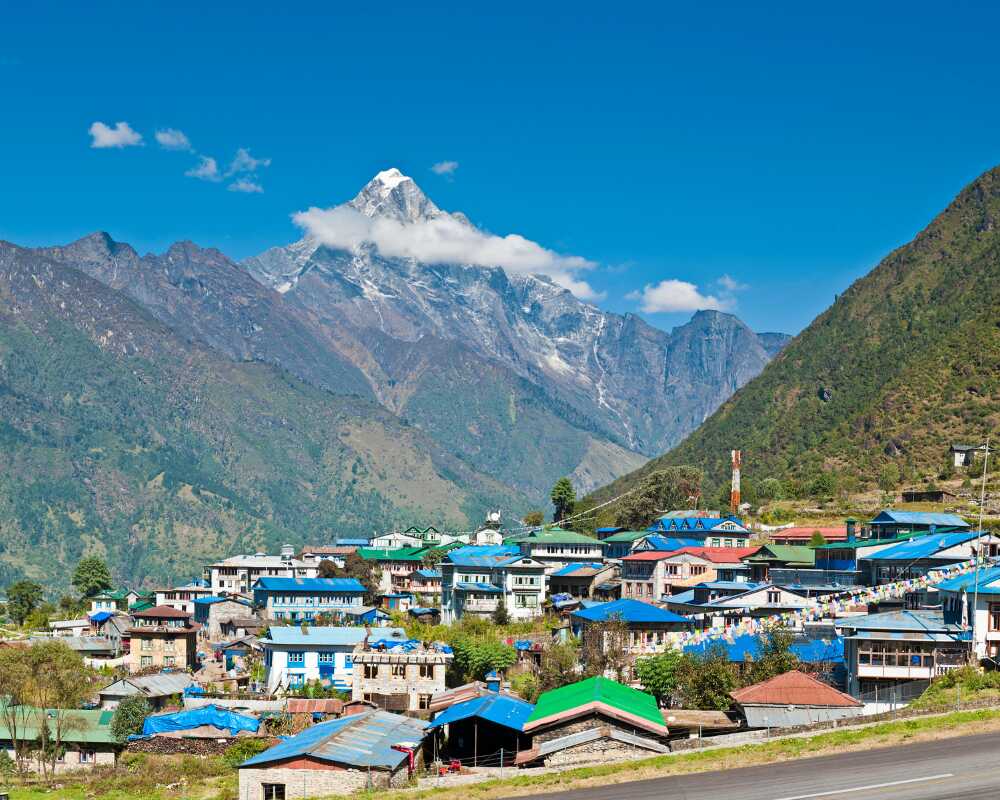
Once you're actually on the ground, Lukla itself is a small, dense trail town built almost entirely around the trekking economy: teahouses, gear shops, bakeries, and porters organizing loads for the day's groups.
Most itineraries, ours included, don't push straight into serious elevation gain from here; the first day typically runs a few hours down to Phakding, a gentler start that also gives you a first read on how your body's handling the jump from Kathmandu's roughly 1,400 meters to Lukla's 2,845. That gradual approach matters more than it might seem to on paper. You're already at meaningful altitude the moment you step off the plane, and the trek itself starts building acclimatization from that first afternoon.
From Phakding, the trail continues up toward Namche Bazaar and the rest of the Khumbu, but that's the next stage of the trip, not this one. For now: the flight is behind you, the trek is ahead of you, and the hardest logistical uncertainty of the whole trip is done.
Ready to see the full route from here? For a complete walkthrough of the entire trek, permits, difficulty, trail stages, and cost, see the Everest Base Camp Trek: The Complete Guide or explore the complete Everest Base Camp Trek itinerary with Outshine Adventure.
The bottom line
The Lukla flight earns its reputation honestly: a short, sloped runway, a firm mountain on one side and open air on the other, and half an hour that turns a trip you've been planning for months into something real. It deserves respect, not dramatization. Understood properly, it's a well-managed piece of extreme-terrain aviation, flown by specialists, with delays built into the system as a safety feature rather than a flaw.
That's exactly why we treat it as the first real decision point in any Everest Base Camp itinerary, not an afterthought squeezed in before the "real" trek begins. A trip that plans for this flight, rather than hoping it goes smoothly, tends to be a trip where a weather hold is a minor inconvenience instead of a crisis.
That's the difference Outshine Adventure builds in from day one: buffer days positioned around the flight, direct coordination with airlines during disruptions, a helicopter contingency when it's genuinely needed, and guides who have made this flight, and handled its delays, more times than they can count. If Lukla has been the part of this trek making you hesitate, that's worth talking through directly. Get in touch and we'll walk you through exactly how your itinerary would handle it, or explore the full Budget Everest Base Camp Trek to see how it all fits together.
FAQ
Is Lukla really the world's most dangerous airport? It's often labeled that way because of the short, sloped runway and lack of a go-around option, and those constraints are real. It's also flown by specifically certified pilots under deliberately conservative rules: marginal flights are cancelled rather than attempted. The bigger everyday risk for trekkers is delay, not an unsafe landing.
How long is the flight? About 30–35 minutes from Kathmandu, or 15–20 minutes from Ramechhap during peak-season routing.
What happens if my flight is delayed or cancelled? You're rebooked onto the next available flight, usually at no extra cost, and wait it out with food and accommodation at either end. Multi-day holds are uncommon but do happen; a well-planned itinerary builds in a buffer day for exactly this.
Why do some flights leave from Ramechhap instead of Kathmandu? During peak season, flights shift to Manthali Airport in Ramechhap to avoid congestion at Kathmandu's single-runway airport and take advantage of a longer, more reliable morning weather window, at the cost of an early-morning drive to get there.
Can I reach Lukla without flying? There's no road into Lukla. The alternative is trekking in from Jiri or Salleri, which adds roughly a week of walking before the standard EBC route even begins, a deliberate choice for trekkers with extra time, not really a practical workaround.
.webp)