-(1).webp)
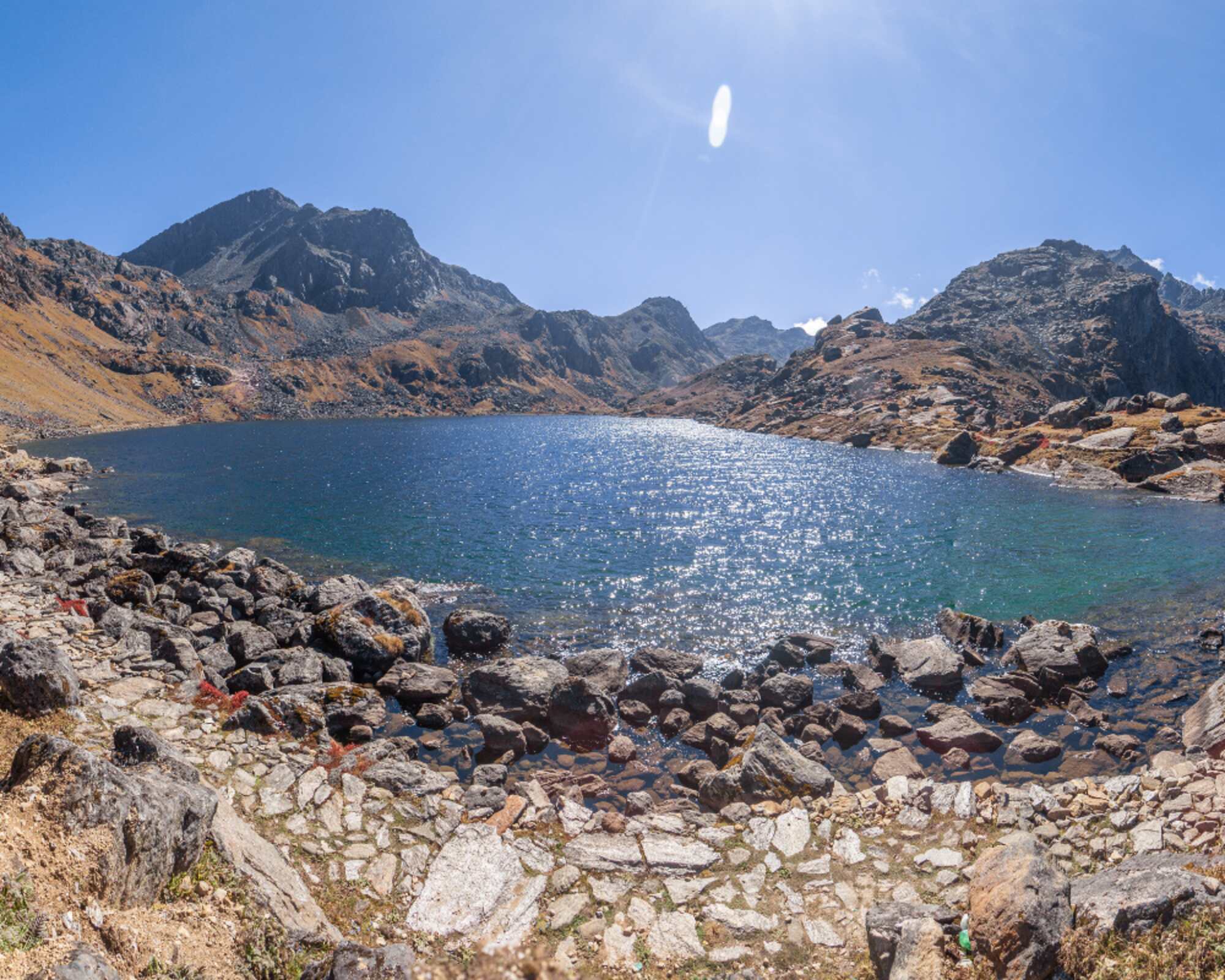
There's a particular kind of quiet that sits over Gosaikunda most of the year. Then, once every August, that quiet breaks. Tens of thousands of pilgrims climb the same stone trail our trekkers walk, and for one night the highest lake above the Langtang region turns into one of the most moving religious gatherings in the Himalaya.
Most trekkers who come to Nepal are chasing a summit, a viewpoint, or a base camp stamp in a passport, and there's no shortage of Nepal trekking packages built around exactly that. This trip asks something slightly different of you. You're not just walking toward scenery, you're walking toward a date on the calendar, timing your arrival to the same night that pilgrims, priests, and shamans have walked toward for centuries. That changes how you plan the trip, and it's worth understanding fully before you lock in your dates.
Langtang itself is what makes this possible. Sitting just north of Kathmandu along the Tibetan border, it's one of the few regions in Nepal where a short drive from the capital drops you straight into ancient forest, grazing yaks, and high alpine basins, no internal flight required. The valley rebuilt steadily after the 2015 earthquake, and the teahouses and trails you'll walk today reflect that recovery: sturdier, better run, and staffed by communities who've spent a decade re-earning the trust of trekkers. If you've ever wanted to time a trek to something bigger than mountain views, Gosaikunda during Janai Purnima is it.
What Is Janai Purnima? (The Sacred Thread Festival)
Janai Purnima falls on the full moon of Shrawan in the Nepali lunar calendar, usually late July or August on the Gregorian calendar. It's one of those festivals that wears several names depending on who you ask and where you are in Nepal.
- Janai means the sacred thread, a length of cotton cord worn across the chest by Hindu men, mostly from Brahmin and Chhetri communities, after their Bratabandha (coming-of-age) ceremony.
- On this day, men bathe in a holy river or lake, cast off last year's thread, and have a priest tie on a fresh one while chanting mantras. It's a ritual of purification and renewal, done annually for life.
- The same day is also Raksha Bandhan, when sisters tie a rakhi around their brothers' wrists as a symbol of protection and love.
- Newar communities in the Kathmandu Valley call it Gunhi Punhi or Kwati Purnima, marked by a hearty soup made from nine to twelve kinds of sprouted beans, traditionally eaten to build strength going into the rainy season.
So Janai Purnima isn't one single ritual. It's a layered festival, sacred thread renewal, sibling bonds, and a seasonal food tradition, all landing on the same full moon.
When Is Janai Purnima in 2026?
This year, Janai Purnima falls on Friday, August 28, 2026 (12th of Bhadra, 2083 in the Nepali calendar). The full moon period, or Purnima Tithi, technically begins the evening before, on August 27, so the atmosphere at Gosaikunda builds through that night and peaks on the 28th.
What that means for trek planning:
- Teahouses at Gosaikunda and along the approach fill up fast in the days before the full moon. Booking three to four weeks ahead is not optional if you want a bed near the lake itself.
- Trail traffic is heaviest on the two to three days surrounding the festival. If you want to witness the ritual without being swept into the busiest crowd, aim to arrive a day early.
- This timing sits right at the tail end of monsoon, so trail conditions and visibility are part of the trade-off for witnessing the festival. We'll compare that to other seasons further down.
The Route: Kathmandu to Gosaikunda and Back
This is the standard itinerary for reaching Gosaikunda, built to combine the sacred lake with the best of Langtang Valley in a single 11-day Gosaikunda Trekking loop out of Kathmandu.
Trip at a glance:
- Duration: 11 Days
- Destination: Nepal
- Difficulty Level: Strenuous
- Maximum Altitude: 4,300m
- Activity: Trekking
Trip highlights:
- Stunning views of Langtang Himal, Ganesh Himal, Manaslu Range, and Tibetan Peaks
- Glorious views of Saraswati Kunda, Bhairab Kunda, and Gosaikunda Lake
- Breathtaking sceneries across forest, meadow, and high alpine terrain
- Old monasteries along the trail
- Insight into the culture, tradition, and lifestyle of locals
The trail itself earns that "strenuous" rating honestly. It winds through rhododendron and pine forest, alongside rivers and streams, and through a string of small villages, meadows, and cultivated fields before climbing into open alpine ground. Expect several steep ascents and descents on rugged sections, especially in the days around Thulo Syabru and Singompa, which is exactly what makes the trek feel adventurous rather than a simple walk-in. On clear days near the higher points of the route, you'll also catch views of the Annapurna Range (8,091m) well beyond the Langtang and Ganesh Himal peaks closer at hand, with the Manaslu Range also visible from several points on the trail.
Permits and Documentation
Two permits cover this route: the Langtang National Park entry permit and the Trekkers' Information Management System (TIMS) card. These need to be sorted in Kathmandu before driving out to Syabru Bensi, since there's no permit office along the trail itself. A valid passport with at least six months' validity and a couple of passport photos are enough to process both. For a fuller rundown of what to sort out before you fly, see our trekking information guide.
Group Size and Guide Ratio
This trek is typically run in small groups, anywhere from two to twelve trekkers, with a licensed guide and porter support scaled to group size. Smaller groups move faster and get more flexibility around festival-day timing at the lake, while larger groups benefit from a lower per-person cost and a built-in sense of camaraderie on the long uphill days. Private and custom-dated departures are also common for trekkers who want to lock in specific dates around August 28 without joining a fixed group.
Physical Preparation
You don't need mountaineering experience, but you do need a working level of cardiovascular fitness. Regular hiking, running, or stair training in the two to three months before departure makes a real difference on the sustained climbing days between Thulo Syabru, Singompa, and Gosaikunda. If you can comfortably manage a few hours of hill walking with a light pack back home, you're in reasonable shape for this route.
Day-by-Day Itinerary (Gosaikunda Trekking, 11 Days)
| Day | Route | Altitude | Walking Time |
|---|---|---|---|
| 1 | Drive Kathmandu to Syabru Bensi | 1,462m | 8 hours (drive) |
| 2 | Trek to Lama Hotel | 2,500m | 5 hours |
| 3 | Trek to Langtang Village | 3,307m | 5 hours |
| 4 | Trek to Kyanjin Gompa, explore the valley | 3,798m | 4 hours |
| 5 | Trek back to Lama Hotel | 2,500m | 6 hours |
| 6 | Trek to Thulo Syabru | 2,250m | 5.5 hours |
| 7 | Trek to Singompa, visit cheese factory and monastery | 3,250m | 5 hours |
| 8 | Trek to Gosaikunda | 4,300m | 5 hours |
| 9 | Trek back to Thulo Syabru | 2,250m | full day |
| 10 | Trek to Dhunche | 2,000m | short day |
| 11 | Drive back to Kathmandu | 1,300m | 6 to 7 hours |
Why Gosaikunda, Under That Same Full Moon
Which brings us back to the name of this guide. Of all the holy sites in Nepal, why does a remote alpine lake at over 4,000 meters, at the end of that eight-day walk above, pull in tens of thousands of people on one specific night?
The legend is simple and dramatic. During the churning of the cosmic ocean, Lord Shiva swallowed poison to save the universe, and his throat burned. To cool himself, he struck his trident into a Himalayan ridge, and water rose up to form Gosaikunda. Some versions say a rock visible beneath the lake's surface is Shiva's own lingam. Either way, the lake is treated as living proof of that story, not just a symbol of it, which is exactly why standing at its shore under the full moon carries the weight it does.
That's the piece that makes this trek different from any other route out of Kathmandu. A few points worth knowing:
- Gosaikunda is sacred in both Hindu and Buddhist tradition, and on Janai Purnima you'll see saffron-robed Hindu priests alongside Buddhist pilgrims performing their own rites at the same shore.
- Traditional shamans, known locally as Dhami-Jhankri, dress in white robes and feathered headdresses and go into trance states at the lake during the festival, a practice tied to older shamanic traditions of the hills that predate organized Hinduism in this region.
- Bathing in the lake on Janai Purnima is believed to cleanse sin and bring prosperity and long life to the bather's family.
- Nearby smaller lakes, Saraswati Kunda and Bhairab Kunda, sit within the same basin and are visited as part of the same pilgrimage circuit.
Pashupatinath in Kathmandu and Kumbheshwor in Lalitpur both draw enormous crowds on the same day. But Gosaikunda is the one place where the pilgrimage and the trek are the same act. You don't arrive by road or by taxi. You walk for it, over the same passes and forest described in the itinerary above, the same way devotees have for generations, and that effort is exactly what makes standing at the lake under the full moon feel earned rather than watched. It's why we titled this guide the way we did: the lake doesn't just happen to sit under a full moon once a year, the walk to reach it under that moon is the whole point.
Want to Go Further? Related Packages Worth Knowing
If the 11-day loop isn't quite the shape of trip you're after, Outshine Adventure runs several other Gosaikunda-linked itineraries in the same Langtang region, depending on how much time and altitude you want to take on.
| Package | Duration | Max Altitude | Route Focus | Starting Price |
|---|---|---|---|---|
| Langtang Valley Trekking | 8 Days | 3,798m | Langtang Valley only, no Gosaikunda | US$650 |
| Gosaikunda Trekking | 11 Days | 4,300m | Langtang Valley plus Gosaikunda, out and back | US$845 |
| Gosainkunda Pass Trek | 12 Days | Approx. 4,610m | Crosses the high pass above the lake | US$1,060 |
| Langtang Gosaikunda and Helambu Trek | 19 Days | Approx. 4,610m | Full traverse through Langtang, Gosaikunda, and Helambu | Contact for quote |
| Helambu Trekking | 21 Days | Lower, forested | Gentler pace, strong village and cultural focus | Contact for quote |
The Gosainkunda Pass Trek and the Langtang Gosaikunda and Helambu Trek are the two to look at if you want to cross the high pass above the lake and descend into Helambu on the far side instead of walking back the way you came. It's a longer, more demanding option, but it turns the trip into a full traverse rather than an out-and-back, and it's a genuinely different experience once you drop into Helambu's Hyolmo villages on the other side.
Beyond the Classic Road: A Lesser-Known Way to Gosaikunda
The 11-day loop above is the version we and most guided operators run, built around the road access at Syabru Bensi and the established chain of teahouses from there to the lake. It's worth knowing, though, that this isn't the only way in.
Gosaikunda sits inside a wider basin that can also be reached from Sundarijal, from Melamchigaon on the Helambu side, or along the Shivapuri ridge, and Outshine Adventure's own Gosainkunda Pass Trek and Langtang Gosaikunda and Helambu Trek packages use variations of these approaches to turn the trip into a traverse rather than an out-and-back.
The Hidden Approach: In Through Nuwakot
Then there's a route almost nobody talks about. Instead of starting from Dhunche or Syabru Bensi, it climbs in from the Nuwakot side, around Dupcheswor, and it's still largely unknown to trekkers and even to many local guides despite sitting relatively close to Kathmandu. Pieced together properly, it works as roughly a week-long circuit, and it turns the walk to Gosaikunda into something closer to an expedition through a hidden lake district than a there-and-back pilgrimage trail.
The climb in is gradual at first: up through Mangengoth, then on to Thadepati at around 3,400m, where rhododendron forest gives way to the first big views of the Gosaikunda Himalayan range. From Thadepati, the trail pushes on to Phedi (roughly 4,000m), and then comes the sting in the tail, a steep 600m push up to Surya Kunda at about 4,610m, the highest lake in the entire basin.
A Basin of Over a Hundred Lakes
This is where the route earns its reputation. Most trekkers who reach Gosaikunda see one lake and turn around. This approach strings together dozens of them, and locals say the wider basin holds well over a hundred, most never named, let alone visited:
- Surya Kunda: the highest lake in the basin, reached after a punishing final climb from Phedi
- Nilkantha Kunda and Barda Kunda: passed on the descent toward Gosaikunda itself
- Bhairab Kunda: famous locally for appearing to shift color through the day
- Saraswati Kunda: reached via a steep, rocky descent below Bhairab Kunda
- Lamu Kunda: a long, narrow lake, long enough that simply walking its length takes real time
- Raja Rani Kunda and Nau Kunda: sitting side by side in the same high valley
- Ekle Kunda: the loneliest of the group, tucked among abandoned yak and sheep grazing grounds
Along the way, the ridgelines open up to sweeping views of the Rolwaling, Jugal, Langtang, and Ganesh Himal ranges, layered one behind the other, and the trail drifts through pockets of Tamang and Hyolmo village life that most Gosaikunda itineraries never touch.
The Catch: This Is Not a Teahouse Trek
Here's the part worth being honest about. Past Ekle Kunda, the trail turns genuinely wild, crossing landslide-damaged ground near Rauchuli before dropping steeply toward Sagar Kunda and finally Malbarjyang in Nuwakot, where terraced fields and village life reappear. Beyond Bhairab Kunda, there are no teahouses or lodges, only the occasional herder's shed, so this route currently suits self-sufficient, camping-based trekking, not the teahouse-to-teahouse comfort of the itinerary above. It isn't waymarked the way the main Dhunche route is either, and exposed ridgelines, loose scree, and easy-to-lose trail sections are all part of the deal.
For most trekkers, and especially anyone timing a trip around Janai Purnima, the established road-and-teahouse route through Syabru Bensi is still the smarter, more reliable way to reach the lake for the festival. But if you're an experienced, well-equipped trekker chasing something genuinely off the map, a basin with a hundred lakes hiding in it, it's worth asking your guide about custom-routing through Nuwakot. It's a real option. Most itineraries just never mention it.
Best Time to Trek Gosaikunda: A Season-by-Season Comparison
Janai Purnima isn't the only time to walk this trail, but it is the only time you'll see it like this.
| Season | Months | Weather & Trail Conditions | Best For |
|---|---|---|---|
| Festival season (Janai Purnima) | Late Aug | Tail end of monsoon, some rain lower down, clear windows near the lake, trails busy with pilgrims | Cultural immersion, the full moon ritual, a once-a-year atmosphere |
| Autumn | Sept to Nov | Stable, dry, crisp mountain air, best visibility of the year | Classic mountain views, comfortable trekking, most popular season overall |
| Spring | Mar to May | Rhododendron forests in full bloom, warm days, occasional afternoon haze | Wildflowers, forest scenery, moderate crowds |
| Winter | Dec to Feb | Cold, snow likely near the pass, some teahouses close, fewer trekkers | Solitude, snow scenery, only for well-prepared and experienced trekkers |
If witnessing Janai Purnima is the whole point of your trip, late August is non-negotiable, and you plan your booking around it rather than the other way around. If you're more flexible and just want the best hiking conditions, autumn wins on nearly every metric except crowd size and festival atmosphere.
Terrain: Forest, Alpine Meadow, and Rock
The trail changes character almost every day, and that's part of what makes this route so satisfying to walk.
Lower down, through Syabru Bensi and up the Langtang Khola, you're under a canopy of oak, rhododendron, and pine, with bamboo thickets in the damper gullies. It's humid, green, and full of birdsong, especially if you're trekking during or just after monsoon for the festival. This lower stretch is also where you'll pass through the small Tamang and Sherpa villages and cultivated fields that give the trek its cultural texture, and where a bit of luck might put a red panda in your path.
Above Kyanjin Gompa and again above Singompa, the forest thins out fast. Trees get shorter and more wind-bent until you're walking through open alpine meadow and scrub, the kind of landscape where the sky suddenly feels much bigger. Old monasteries and yak pastures mark this middle stretch, including the ancient Buddhist monastery and yak cheese factory at Singompa, both firmly on the day's route.
Near Lauribinayak and the lake itself, it's rock, scree, and bare ground. Loose stone underfoot, sparse vegetation, and real exposure to wind and cold. Trekking poles earn their keep on this stretch.
Acclimatization and Altitude on the Way to Gosaikunda
The 11-day itinerary is built the way it is for a reason, and it isn't just to show you more of Langtang Valley. Walking up to Kyanjin Gompa first, spending a half day exploring around 3,798m, then descending back down to Lama Hotel before climbing again toward Singompa and Gosaikunda gives your body two separate chances to adjust before you touch 4,300m. That up-down-up rhythm is standard acclimatization practice in the Himalaya, and it's a big part of why this route is safer than a direct push up from Dhunche in fewer days.
Even with that built-in buffer, altitude is worth taking seriously on this trek. Mild headaches, fatigue, and shortness of breath on the climb toward Lauribinayak and the lake are common and usually resolve with rest, water, and a slower pace. Anything more severe, confusion, loss of coordination, or symptoms that worsen instead of easing, is your guide's cue to descend immediately rather than push on for the festival. Our guides carry basic altitude medication and are trained to make that call, but the best protection is simply not rushing the schedule, especially in the days right before Janai Purnima when it's tempting to hurry to beat the crowds. Read more in our guide to high altitude sickness if you want to understand the symptoms and precautions in more depth.
Drink more water than feels necessary, avoid alcohol until you're back down near Dhunche, and eat well even when your appetite dips at altitude, garlic soup is a teahouse staple along this route for good reason. If you're trekking with a preexisting heart or lung condition, talk to a doctor before booking, and let your guide know on day one so they can watch for it. It's also worth reviewing our travel insurance guide beforehand, since a policy covering high-altitude trekking and emergency evacuation is essential for this route.
Accommodation, Meals, and Local Support on the Trail
This isn't a camping trek. From Syabru Bensi all the way up to Gosaikunda, you're staying in family-run teahouses, simple twin rooms with shared bathrooms lower down, thinner walls and colder nights the higher you climb. Near the lake itself during festival season, rooms are basic and in high demand, which is exactly why early booking matters more here than on almost any other Langtang route.
Meals follow the standard teahouse rhythm: breakfast and dinner at whichever lodge you're staying in, lunch on the trail at a stop along the way. Dal bhat is the reliable, refillable staple at altitude, but you'll also find noodle soups, momos, porridge, and the odd pizza lower down in Syabru Bensi and Thulo Syabru. Garlic soup shows up on most menus above 3,000m, a local remedy for altitude that's worth ordering even if you're feeling fine.
You won't be walking this route unsupported. A local, government-licensed, English-speaking guide leads the trek from day one, backed by porters who carry the bulk of your gear so you're only managing a light daypack. That local knowledge matters most in the days around the festival itself, reading crowd flow at the lake, knowing which teahouses have space, and making the call to slow down or descend if altitude symptoms show up. Outshine Adventure also provides a down jacket, sleeping bag, and duffel bag for the trek, so you're not buying or renting cold-weather gear you'll only use once.
Practical Trekking Tips for Janai Purnima
A few things we tell every trekker booking this route around festival dates:
- Book your guesthouse spots and guide early. Late August is peak demand around Gosaikunda. Waiting until the last minute means sleeping further from the lake than planned.
- Pace your acclimatization properly. Even on this itinerary, you're gaining serious altitude between Kyanjin Gompa and Gosaikunda. Don't rush the Singompa stop.
- Pack for both rain and cold. You're trekking at the edge of monsoon, so a good rain shell matters as much as a warm down layer for the lake.
- Bring proper footwear with grip. The scree sections near Lauribinayak get slick, especially after recent rain.
- Carry cash in smaller notes. ATMs disappear once you leave Dhunche or Syabru Bensi, and teahouse prices climb with elevation.
- Respect the ritual space. If you're at the lake during the festival itself, keep a respectful distance from pilgrims performing their bath and thread-changing rituals unless you've been invited to take part, in line with the responsible tourism practices we ask all our trekkers to follow.
Basic packing list:
- Layered clothing (base layer, fleece, waterproof shell)
- Sturdy, broken-in trekking boots
- Trekking poles
- Warm sleeping bag rated for near-freezing temperatures (or use the one included in our package)
- Headlamp, water purification tablets or filter
- Sun protection: hat, sunglasses, sunscreen
- Basic first aid kit and any personal medication
- Cash in Nepali rupees, small denominations
For a fuller checklist with layering advice and gear recommendations, see our trekking equipment guide, and cross-check it against our general essential travel checklist before you fly.
Frequently Asked Questions
Do I need previous trekking experience for Gosaikunda? Prior teahouse trekking experience helps, but it isn't required. What matters more is a reasonable level of fitness and a willingness to walk five to six hours a day on variable terrain. First-time trekkers join this route every year, usually training with regular hiking or cardio in the two to three months before departure.
Can non-Hindus and non-Buddhists witness the festival at the lake? Yes. Visitors of any background are welcome to observe from a respectful distance. You won't be asked to take part in the rituals themselves, and photography is generally fine away from the immediate bathing areas, though it's courteous to ask before photographing individual pilgrims up close.
Is it safe to trek during monsoon season for Janai Purnima? It's manageable, but it's not the calm, dry conditions of autumn. Expect some rain and leech activity in the lower forested sections, occasional trail delays, and mistier viewpoints lower down. Above Singompa, the weather tends to clear more often than not, which is part of why the route still works well for the festival despite the season.
What if I can't get a teahouse bed right at Gosaikunda for the festival night? This happens in busy years even with early booking. Our guides keep backup arrangements at Lauribinayak and Singompa, both close enough to reach the lake for the ritual itself while giving you a guaranteed bed to return to.
Where the Trail and the Festival Meet
There's something that stays with you about standing at Gosaikunda on the night of a full moon, watching thousands of people arrive on foot for something that predates any trekking itinerary or map. This trek offers glacier-carved valleys, an old Buddhist monastery, a working yak cheese factory, and one of the most sacred lakes in the Himalaya. Janai Purnima gives that same walk a reason that has nothing to do with tourism at all.
If you're thinking about timing a 2026 trek around August 28, now is the moment to start planning, not closer to the date, when teahouses near the lake are already full.
For anyone looking for a guided, fully supported version of this trip, Outshine Adventure runs this exact Gosaikunda Trekking route out of Kathmandu and can help figure out whether the 11-day loop, the pass crossing, or the full Helambu traverse fits your time and fitness or can customize as per the traveller preference. Get in touch with Outshine Adventure to start planning a Gosaikunda and Janai Purnima trek.