-(2).webp)
The Manaslu Circuit Trek requires more permits than any other trek in Nepal a restricted area permit, a conservation area permit, a second conservation area permit for the exit section, and a local municipality fee. This is because the route passes through a government-designated restricted border zone as well as two separate conservation areas. Here's exactly what each permit costs in 2026/2027 and how to get them.
What Permits Do You Need for the Manaslu Circuit Trek?
Four permits are required to complete the full circuit:
- Manaslu Restricted Area Permit (MRAP) — covers the restricted zone between Jagat and Dharapani
- Manaslu Conservation Area Permit (MCAP) — required to enter the Manaslu Conservation Area
- Annapurna Conservation Area Permit (ACAP) — required for the Dharapani exit section, since the trail crosses into the Annapurna Conservation Area
- Tsum Nubri (Chum Nubri) Rural Municipality Fee — a one-time local fee collected at the Jagat checkpoint
What Is Each Permit For, and Why Does It Matter?
Before getting into exact costs, it helps to understand what each permit actually does they're not interchangeable, and each one exists for a different reason.
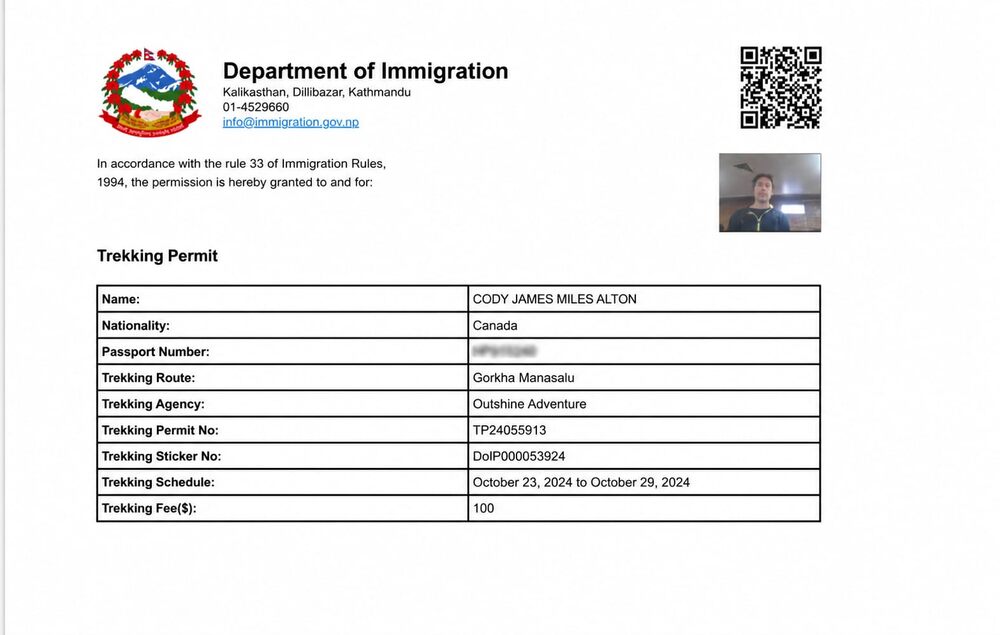
Manaslu Restricted Area Permit (MRAP) :
The MRAP is a government-issued permit that grants access to a designated restricted zone along Nepal's border with Tibet. This area is classified as restricted for security and environmental reasons, so the government controls exactly who enters, for how long, and through which registered agency. Without this permit, you cannot legally set foot on the trail between Jagat and Dharapani checkpoint police along the route verify it in person, and trekking without one risks being turned back or fined. It's the most important of the four permits, and the only one that can't be arranged independently.
Manaslu Conservation Area Permit (MCAP) :
The MCAP funds the conservation and management of the Manaslu Conservation Area, a protected zone that's home to endangered species like the snow leopard and Himalayan tahr, along with fragile high-altitude ecosystems. The fee goes toward habitat protection, community forestry programs, and conservation staff who monitor the area. It matters because it's what legally allows you to trek through conservation-protected land, and the revenue directly supports the environment you're there to see.
Annapurna Conservation Area Permit (ACAP) :
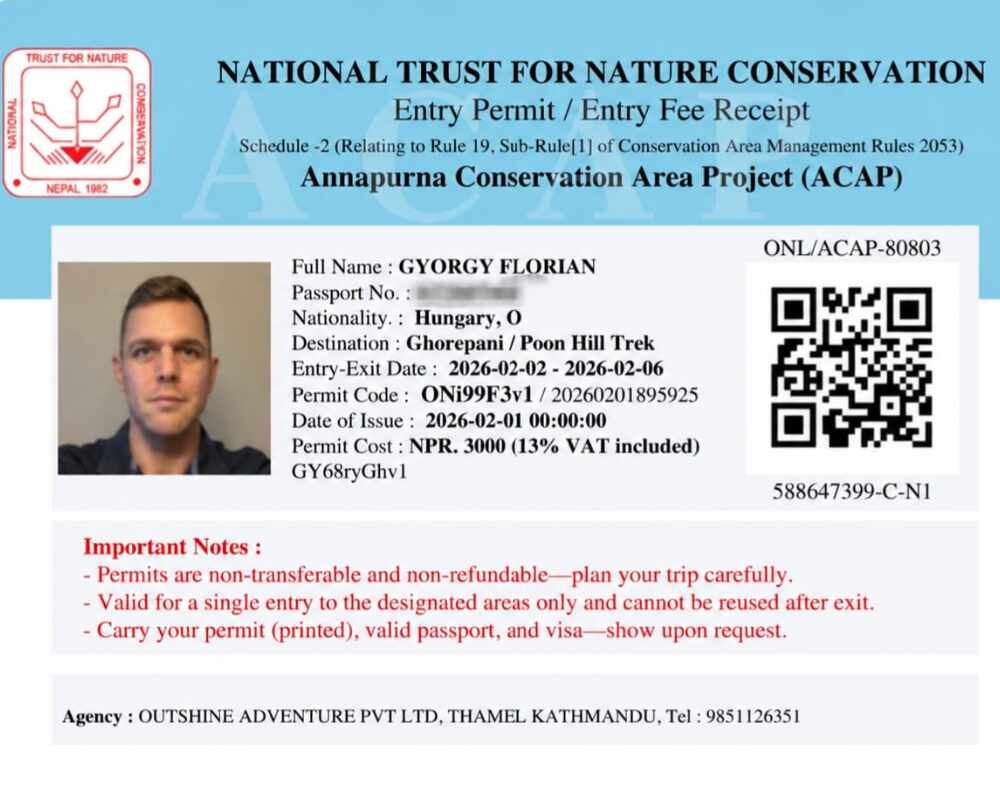
The ACAP serves the same conservation purpose as the MCAP, but for the Annapurna Conservation Area, the zone your route enters once you cross Dharapani on the western side of the circuit. It's easy to overlook because the trek is branded as "Manaslu," but the final section of the trail technically leaves the Manaslu Conservation Area and enters Annapurna's protected territory, which is why a second, separate conservation permit is legally required to complete the circuit.
Tsum Nubri (Chum Nubri) Rural Municipality Fee :
Unlike the other three, this isn't a national government permit it's a local fee charged by the Tsum Nubri Rural Municipality itself. It funds trail maintenance, local infrastructure, and community services in the villages your route passes through, and it's collected in person, in cash, at the Jagat checkpoint. It matters because it's the mechanism that keeps the trail and local facilities functional for trekkers, and skipping it isn't an option since it's checked alongside your MRAP and MCAP at the same checkpoint.
You need all four regardless of which direction you walk the circuit or which teahouses you stay in none of them are optional add-ons. The only permit that changes if you extend your trip is the MRAP, since it's the one priced by the number of days you spend inside the restricted zone. If you're also planning a side trip into Tsum Valley Trek, note that this requires its own separate Tsum Valley Restricted Area Permit on top of the four listed above that's a different permit from the flat Tsum Nubri municipality fee and is priced separately by the week, similar to the MRAP.
Manaslu Circuit Trek Permit Costs 2026/2027
The MRAP is the only permit with variable pricing, it's charged by the week and the rate depends on the season. The other three permits are flat, fixed-rate fees that don't change with the season.
All prices below apply to foreign nationals only.
Permit | Sep–Nov (Autumn) | Dec–Aug (Winter/Spring/Summer/Monsoon) |
| MRAP — first 7 days | USD 100 | USD 75 |
| MRAP — each extra day | USD 15/day | USD 10/day |
| MCAP | NPR 3,000 (~USD 22) | NPR 3,000 (~USD 22) |
| ACAP | NPR 3,000 (~USD 22) | NPR 3,000 (~USD 22) |
| Tsum Nubri Municipality Fee | NPR 1,000 (~USD 8) | NPR 1,000 (~USD 8) |
A note on the MRAP: it's priced by weeks spentinside the restricted zone specifically, not by the total length of your trek. Autumn (September to November) is the only season with the higher USD 100/week rate spring, winter, and the monsoon months all fall under the lower USD 75/week bracket. MCAP, ACAP, and the municipality fee stay the same price all year. The above price If you're still weighing up when to go, our guide to the best year and season to trek in Nepal covers how weather and crowd levels shift across the calendar, on top of the permit savings outlined here.
It's worth understanding why the pricing works this way. The MRAP exists to control and monitor traffic through a sensitive border-adjacent zone, so the government prices it per week spent inside that zone and adjusts the rate seasonally to reflect demand autumn is peak season for clear mountain views, so it carries the premium rate.
MCAP and ACAP, by contrast, are conservation entry fees rather than border-zone permits, so they're charged once as a flat entry fee no matter how long you stay inside the conservation area or what time of year you visit.
The Tsum Nubri fee is smaller still it's a municipal levy rather than a national government fee, collected locally to fund trail maintenance and community services in the villages the route passes through, which is why it's paid in cash directly at the Jagat checkpoint rather than arranged in advance through the Nepal Tourism Board.
One more detail worth knowing before you budget: since 2026/2027, foreign trekkers must pay MRAP fees in US dollars, while Indian nationals can pay the equivalent in Nepali rupees. MCAP, ACAP, and the Tsum Nubri fee are typically quoted in Nepali rupees regardless of nationality, though your agency will usually convert and include these in your package total so you don't need to carry large amounts of cash yourself.
How Do You Actually Get the Manaslu Permits? (Step by Step)
The paperwork looks intimidating from the outside, but it's a defined process, and almost all of it is handled by your agency rather than by you directly.
Step 1: Your agency prepares and submits the application
Your agency puts together your MRAP application through the Department of Immigration's official trekking permit portal, along with separate applications for the MCAP and ACAP. This is done on your behalf using the documents you've already sent them, your passport and visa scans, your itinerary with trekking dates, and your insurance details. Since 2026, most of this submission happens online rather than requiring a physical form to be walked into an office, which has cut down processing time considerably compared to a few years ago.
Step 2: The Department of Immigration verifies and issues the permit
Once submitted, an immigration officer cross-checks your details against your original passport and visa, confirms your agency's registration and licensing are current, and processes the government fee payment. For the MRAP specifically, this step still requires your agency's involvement in person at some stage, since the Department of Immigration issues restricted-area permits only to registered agencies rather than to individual applicants. Turnaround is typically same-day to next working day, though it's worth building in a spare day in Kathmandu before you set off, since the immigration office is closed on Saturdays and public holidays.
Step 3: MCAP and ACAP are issued through the Nepal Tourism Board
Separately from the MRAP, the conservation permits are arranged through the Nepal Tourism Board, either online or in person at their Kathmandu or Pokhara offices. Your passport photo is attached to the form, the fee is paid in Nepali rupees, and the permit is printed and signed. Unlike the MRAP, agencies can sometimes arrange these on a walk-up basis if a trekker arrives at a checkpoint without one, though it's far simpler to have them sorted in advance.
Once all three documents are issued, your guide carries the originals for the entire trek you're not expected to hold onto them yourself. The one piece that isn't arranged in Kathmandu at all is the Tsum Nubri Municipality Fee, which is paid in cash directly at the Jagat checkpoint on the trail.
A note on solo trekkers: as of a March 2026 policy update, solo travelers can now apply for a Manaslu Restricted Area Permit individually, without needing to be part of a two-person group as was previously required. This doesn't change the agency or guide requirement you still need both but it does remove the old hurdle of having to find a second trekker just to qualify for a permit.
Can My Trekking Agency Arrange the Permits?
Yes, Outshine Adventure arranges all four permits as part of every Manaslu Circuit Trek package. You won't need to visit a permit office yourself, and the cost is built into your package price with nothing extra to pay on arrival.
If you're arranging your own permits independently, the MCAP and ACAP are obtained at the Nepal Tourism Board office in Kathmandu. The MRAP is different: it can only be issued through a licensed trekking agency, since solo trekkers are not permitted to apply for it directly. This is tied to the Nepal's wider trekking rules, that independent, guide-less trekking is not allowed in the Manaslu restricted area you'll need a registered agency and a licensed guide regardless of how you book.
What Documents Do You Need for the Permits?
- Passport copy (valid minimum 6 months)
- Passport-sized photos (minimum 2)
- Trekking agency letter (your operator provides this)
- Travel insurance documents
Bring physical, printed copies rather than relying on digital scans checkpoint staff along the route work from paper records, and phone or laptop battery isn't something you want to depend on at a police post in Philim or Jagat. Most agencies will ask you to send scanned copies of your passport and photo before your trip so the permits can be processed in Kathmandu ahead of your arrival, then hand you the physical permits once you land. If you're extending your visa or your passport is close to the six-month validity cutoff, sort that out before applying permit offices will reject applications tied to a passport that doesn't clear the minimum validity window. For a broader look at what to expect once you're on the trail in the Manaslu region, see our full trekking guide.
Where Are Permits Checked on the Trail?
Your guide carries the original permits and handles the checkpoint process, but it helps to know where these checks happen. The MRAP and MCAP are first checked at Jagat, which also happens to be where the Tsum Nubri municipality fee is collected. Further checkpoints appear at Philim and other points along the Budhi Gandaki valley as you move deeper into the restricted zone.
The ACAP is checked separately at Dharapani, on the western side of the Larkya La pass, since that's the point where the trail leaves the Manaslu Conservation Area and enters the Annapurna Conservation Area. If you're carrying a Tsum Valley Restricted Area Permit as well, expect additional checks around Lokpa and Chumling before you rejoin the main circuit.
Is TIMS Required for Manaslu Circuit Trek?
No. As of 2026/2027, a TIMS (Trekker's Information Management System) card is not separately required for the Manaslu Circuit Trek. The Tsum Nubri Rural Municipality Fee collected at Jagat, combined with the MRAP itself, covers the registration function that TIMS normally serves. You won't need to buy a TIMS card before departure for this route though if you continue on from Dharapani into the wider Annapurna Circuit, TIMS does apply to that onward section. If Manaslu is one of several Himalayan routes you're weighing up, our roundup of the best trekking spots in South Asia is a useful starting point for comparing options.
Total Permit Cost for Manaslu Circuit Trek 2026/2027
Here's a worked example for a typical spring departure, where the restricted zone (Jagat to Dharapani) takes around 9 days to walk:
- MRAP: USD 75 for the first week + 2 extra days at USD 10/day = USD 95
- MCAP: NPR 3,000 ≈ USD 22
- ACAP: NPR 3,000 ≈ USD 22
- Tsum Nubri Fee: NPR 1,000 ≈ USD 8
- Total: approximately USD 147 per person in spring
The exact figure moves with how many days you actually spend inside the restricted zone, so it's worth checking your specific itinerary against the table above. In autumn, the same 9-day stretch would come to roughly USD 172, since the MRAP jumps to the higher weekly rate.
For a longer itinerary say a 12-day stay inside the restricted zone, which some trekkers choose to allow extra acclimatization days before Larkya La the numbers look like this:
Season | MRAP | MCAP | ACAP | Tsum Nubri Fee | Total |
| Spring/Winter/Summer | USD 125 (USD 75 + 5 days × USD 10) | USD 22 | USD 22 | USD 8 | USD 177 |
| Autumn | USD 175 (USD 100 + 5 days × USD 15) | USD 22 | USD 22 | USD 8 | USD 227 |
The takeaway is that every additional day inside the restricted zone adds USD 10 in spring or USD 15 in autumn to your permit bill, on top of the fixed USD 52 you'll pay for MCAP, ACAP, and the Tsum Nubri fee combined. If your itinerary is flexible, shaving a day or two off your time between Jagat and Dharapani without cutting your acclimatization days short is the only real lever you have for reducing your permit cost.
All permits are included in Outshine Adventure's package price, so whichever season you book, there's no additional permit cost to handle on arrival. If you're still deciding between routes, our Manaslu vs Annapurna Circuit comparison breaks down how the permit costs, crowd levels, and trail conditions compare between the two treks.
Ready to book? View our Manaslu Circuit Trek packages from US$830 per person.
.webp)
-(1).webp)
-(1).webp)