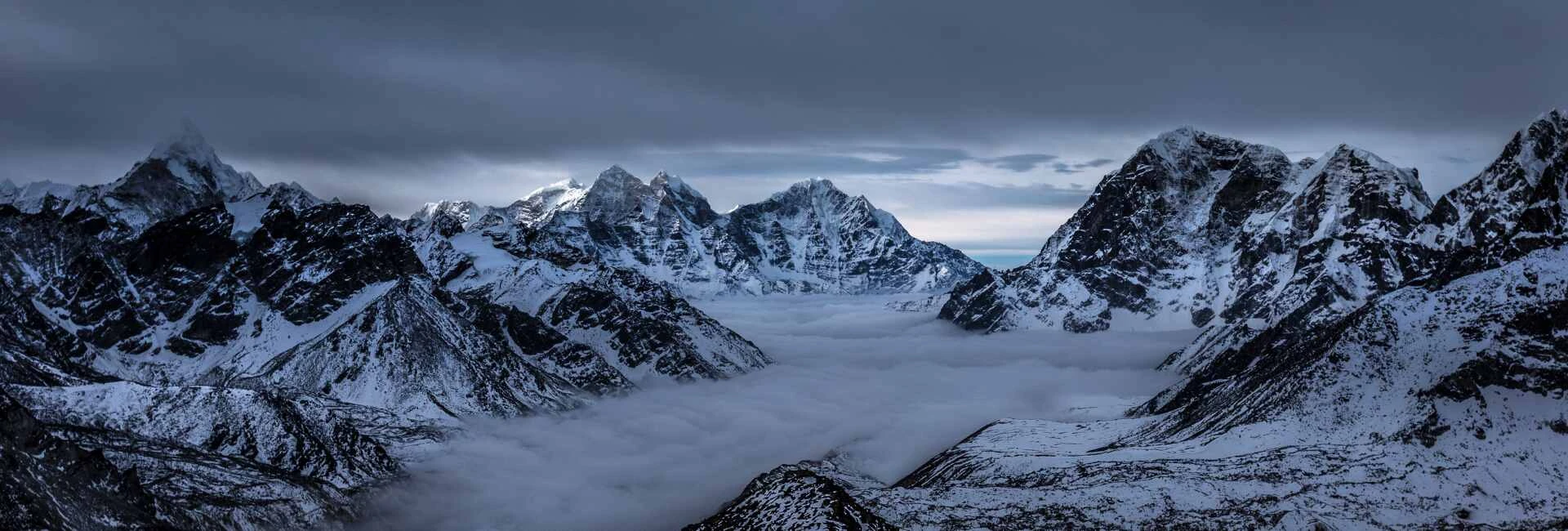
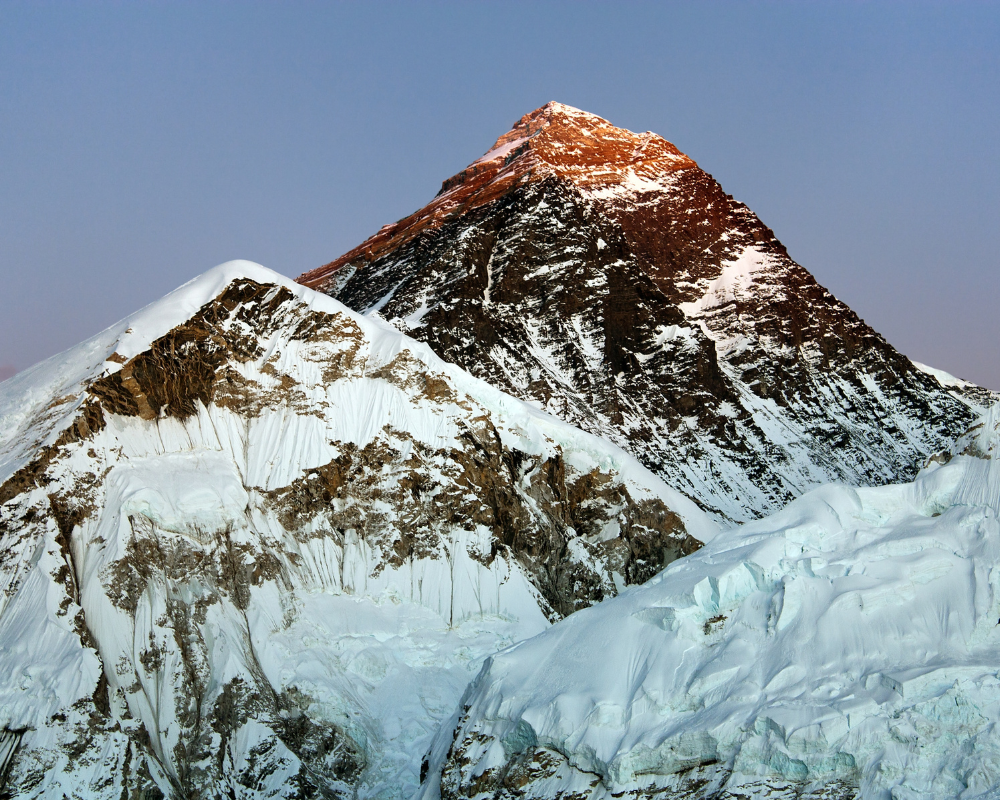
If you have ever seen a photo captioned "Everest Base Camp trek" with a perfect pyramid of rock and ice glowing gold at sunrise, chances are you were not looking at Base Camp at all. You were looking at Kala Patthar. Base Camp itself sits in a boulder field with no direct line of sight to Everest's summit. Kala Patthar is the viewpoint that actually delivers the shot, and for most trekkers, it is the true emotional peak of the journey.
This guide covers everything you need to plan the climb: what it is, the story behind its name, which mountains you'll see, when to go, how to prepare, what challenges to expect, and whether a beginner can realistically make it to the top.
What Is Kala Patthar
Kala Patthar is a rocky outcrop jutting from the southern ridge of Pumori, a 7,161-meter peak that straddles the Nepal-Tibet border. It rises directly above Gorak Shep, the last settlement on the Everest Base Camp trail, in the Khumbu region of Nepal's Sagarmatha National Park.
Technically, Kala Patthar is not a mountain at all. Its prominence above the surrounding ridge is only about 10 meters, which means in mountaineering terms it is a shoulder of Pumori rather than an independent peak. That technicality doesn't matter to trekkers, because what Kala Patthar lacks in geological status it makes up for entirely in payoff: it is the single most accessible spot in the entire Khumbu that delivers a close, unobstructed, front-on view of Mount Everest's summit.
There are actually two "tops" people talk about. Most trekkers stop at the lower viewpoint, marked by strings of prayer flags, at around 5,545 meters. A further scramble over loose rock leads to the true summit of the ridge at approximately 5,644 meters (18,519 feet), which is the highest point most guidebooks quote. Either point delivers the classic view, so many trekkers turn back at the flags without feeling they've missed anything.
Kala Patthar was also, for years, home to the highest-altitude live webcam in the world, streaming the Everest panorama back to the internet from a solar-powered rig bolted near the summit.
Facts About Kala Patthar
| Fact | Detail |
|---|---|
| Meaning of the name | "Black rock" in Nepali |
| Elevation (main viewpoint) | ~5,644 m (18,519 ft); prayer-flag viewpoint sits slightly lower at ~5,545 m (18,192 ft) |
| Parent peak | Pumori (7,161 m / 23,494 ft) |
| Status | Not an official mountain, a rocky shoulder/ridge, with only ~10 m of prominence |
| Location | Above Gorak Shep, Khumbu region, Solukhumbu District, Nepal |
| Protected area | Sagarmatha National Park (a UNESCO World Heritage Site) |
| Nearest village | Gorak Shep (5,164 m), roughly a 2-hour walk / 400–500 m elevation gain away |
| Access | On foot only; no roads, cable cars, or vehicle access |
| Terrain | Loose scree, boulders, and rock; steep in the final stretch |
| Best known for | The closest, most unobstructed close-up view of Mount Everest's summit on the entire trek |
| Notable feature | Formerly hosted the world's highest-altitude webcam |
| Popular with | Everest Base Camp trekkers, photographers, and helicopter tour landings |
The Story Behind the Name
The name is refreshingly literal: "Kala" means black and "Patthar" means rock or stone in Nepali, so Kala Patthar simply translates to "Black Rock." The name comes directly from the appearance of the outcrop itself: a dark, wind-scoured pile of rock and scree that stands out against the pale moraine and snowfields surrounding it, especially when seen against the glacier ice of the Khumbu below.
Unlike many Himalayan landmarks that carry religious or mythological names, Kala Patthar's identity was built by surveyors and mountaineers rather than legend. Because it offers a natural, elevated platform with a clean sightline to Everest's summit, it became an important reference point during early 20th-century Everest surveying and expedition planning, long before it turned into a trekking destination in its own right. That practical, survey-era origin is part of why the name never picked up a more poetic Sherpa or Tibetan title the way many surrounding peaks did; it was named for exactly what it looks like, and that plain description is now printed on maps and trekking permits across the region.
Mountains You Can See From Kala Patthar
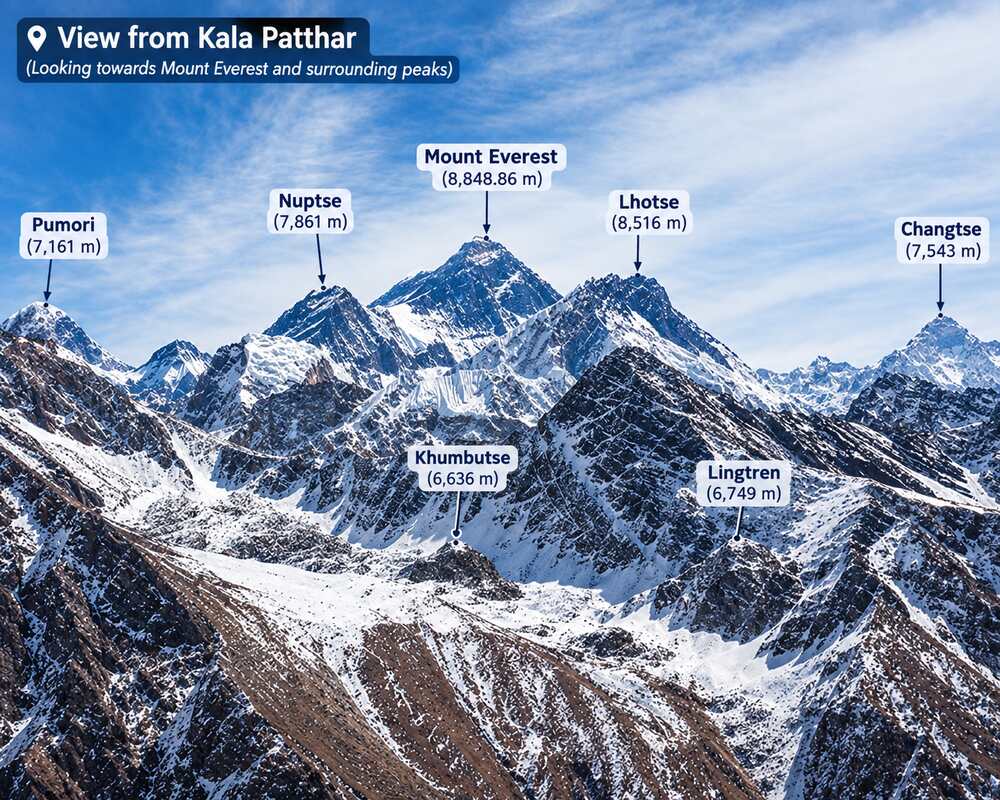
The view from the top isn't just about Everest. Kala Patthar sits at a unique angle on Pumori's ridge that opens up a genuine 360-degree amphitheater of the highest peaks on Earth, all visible from one spot without a lens change.
| Peak / Feature | Elevation | What Makes It Stand Out From Kala Patthar |
|---|---|---|
| Mount Everest | 8,848.86 m (29,032 ft) | The headline view and the reason most people climb. Unlike from Base Camp, the summit pyramid is fully visible here, unobstructed by the Khumbu Icefall or Nuptse's ridge, and it catches the very first light at sunrise. |
| Lhotse | 8,516 m (27,940 ft) | The world's fourth-highest peak, connected to Everest via the South Col. You get a clear look at its north face and upper summit rising just beside Everest. |
| Nuptse | 7,861 m (25,791 ft) | The very peak that blocks Everest's summit from view at Base Camp. From Kala Patthar's higher, angled position, it's visible as its own distinct wall rather than an obstruction. |
| Pumori | 7,161 m (23,494 ft) | The mountain Kala Patthar is physically attached to, rising directly behind and above the viewpoint. Because it's so close, it can look even more dramatic and imposing than Everest itself. |
| Changtse | 7,543 m (24,747 ft) | Everest's northern neighbor, technically across the border in Tibet, visible glowing behind the main massif in the early light. |
| Ama Dablam | 6,812 m (22,349 ft) | Further down the valley toward Namche, but its distinctive, sharply pointed pyramid shape is still recognizable even at this distance. |
| Khumbu Glacier & Icefall | N/A | The frozen river of ice trekkers have been walking alongside for days, seen here from above, along with a rare bird's-eye look down onto the colored tents of Everest Base Camp itself. |
Few other viewpoints on Earth pack this many 7,000- and 8,000-meter peaks into a single frame without needing to change position.
Why Kala Patthar Beats Base Camp for the View
Everest Base Camp is a milestone with huge symbolic weight, but the geography works against it as a viewpoint. The Khumbu Icefall and surrounding ridgelines block a direct view of Everest's summit from Base Camp. Kala Patthar, sitting higher and at a different angle, opens up an unobstructed panorama that includes Everest, Nuptse, and Pumori in one frame.
- Direct summit sightline: Everest's peak is clearly visible from Kala Patthar, unlike from Base Camp
- Better light: sunrise from Kala Patthar hits Everest's summit pyramid first, producing the golden-glow shot most trekkers are chasing
- Wider panorama: Nuptse, Changtse, and Pumori are all visible alongside Everest
- Quieter at the top: fewer people push all the way to the viewpoint compared with the crowds at the Base Camp marker
Kala Patthar vs Everest Base Camp: Quick Comparison
| Feature | Kala Patthar | Everest Base Camp |
|---|---|---|
| Elevation | ~5,644 m (18,519 ft) | ~5,364 m (17,598 ft) |
| Everest summit visible | Yes, direct and unobstructed | No, blocked by the Khumbu Icefall and ridgelines |
| Best time to visit | Pre-dawn for sunrise light | Daytime, often mid-morning |
| Terrain | Steep scramble on loose rock and scree | Flat to rolling boulder field |
| Typical visit length | 2 to 4 hours round trip from Gorak Shep | 1 to 2 hours at the site |
| Crowd levels | Lower, especially before sunrise | Higher, especially in peak season |
| Symbolic value | The visual climax of the trek | The historic and emotional milestone |
| Physical demand | High, due to altitude and gradient | Moderate, mostly altitude-driven |
Top Attractions to Look For at Kala Patthar
Once you're at the top, there's more to take in than just Everest's summit. These are the things worth pausing for:
- The Everest summit pyramid at first light: the reason most people make the climb in the first place.
- The Khumbu Icefall and Everest Base Camp from above: a rare bird's-eye view of the tented camp and the tangled ice you can't get from ground level at Base Camp itself.
- Pumori's south ridge and glacier faces, rising directly overhead since you're standing on its shoulder.
- The prayer-flag viewpoint: strings of Buddhist prayer flags snap in the wind at the lower summit, a favorite photo spot and a marker of how far trekkers before you have come.
- The site of the former highest-altitude webcam, a small reminder that this rock has been watched from around the world.
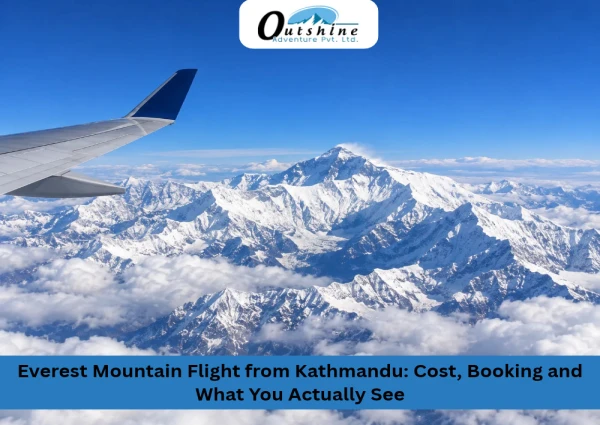
- Helicopter landings: Kala Patthar and Gorak Shep are common landing points for short scenic helicopter tours, so you may see one arrive or depart while you're at the top.For those who can't trek at all, a scenic mountain flight from Kathmandu offers a distant but genuine aerial glimpse of the same skyline without setting foot on the trail.
- The Khumbu Glacier's full length, visible winding down the valley below.
Gorak Shep: The Gateway to Everest Base Camp and Kala Patthar
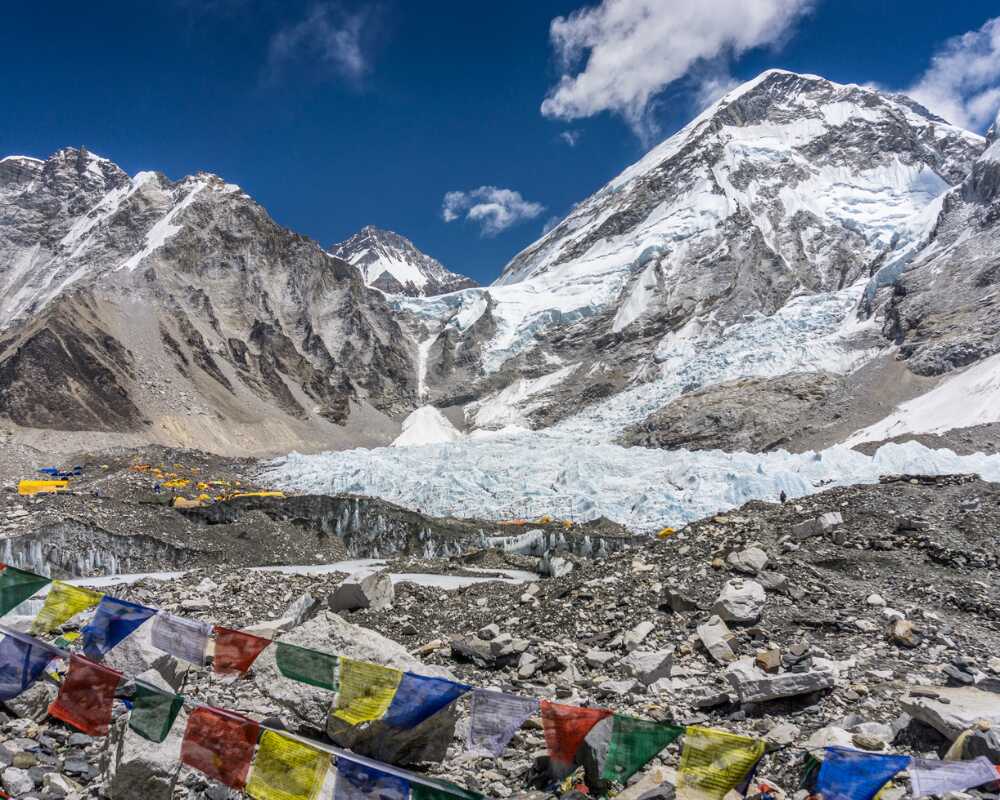
Almost nobody reaches Kala Patthar or Everest Base Camp without passing through Gorak Shep, a small settlement at roughly 5,164 meters that sits on the sandy bed of a glacial lake that dried up long ago. It's the highest place on the entire trail with lodges and beds, and trekking permits require an overnight stop here rather than camping at Base Camp itself.
A few things worth knowing about Gorak Shep before you arrive:
- It's genuinely basic. Expect simple teahouses, thin mattresses, shared toilets, and limited hot water; this is the most stripped-down accommodation on the route.
- It's a hub, not a destination. Trekkers typically arrive from Lobuche, drop their bags, then either push on to Base Camp the same afternoon or rest before a pre-dawn start up Kala Patthar the next morning.
- The name has a bleak backstory. In Sherpa, the name roughly translates to "dead ravens" or "raven graveyard," a nod to the harsh, barren lakebed terrain where almost nothing grows.
- It's the last place to sleep at altitude before your two big pushes. From Gorak Shep, Kala Patthar is roughly a 2-hour climb one way, while Base Camp is a longer, flatter 3-hour walk each way.
- Symptoms show up here first. Because it's the highest overnight stop on the trek, this is where altitude sickness most commonly becomes noticeable, so it's worth taking the short walk from Lobuche slowly and monitoring how you feel before attempting either excursion.
Not everyone arrives at Gorak Shep the same way. Trekkers on the standard route come up via Lobuche, but those on longer itineraries like the Everest Gokyo Trekking, the Everest Circuit Trekking, or the three-pass Everest High Pass Trek reach the same village from the other direction, over the Cho La Pass, after days spent among the turquoise Gokyo Lakes and higher mountain passes. Every one of these routes ends at the same pre-dawn push up Kala Patthar.
Best Time to Climb Kala Patthar
Timing affects both the view and the difficulty. Most guides recommend a pre-dawn start so you reach the top as the sun rises, when the sky is clearest and Everest catches the first light.
- Spring (March to May): stable weather, warmer temperatures, busier trails
- Autumn (late September to November): the clearest skies of the year and the most popular season for this exact reason
- Winter (December to February): fewer crowds, colder temperatures, higher risk of high-wind days
- Monsoon (June to August): frequent cloud cover, lowest odds of a clear summit view
For 2026 specifically, autumn remains the strongest bet for photographers chasing that classic golden Everest shot, with early spring a close second.
Sunrise vs Sunset at Kala Patthar
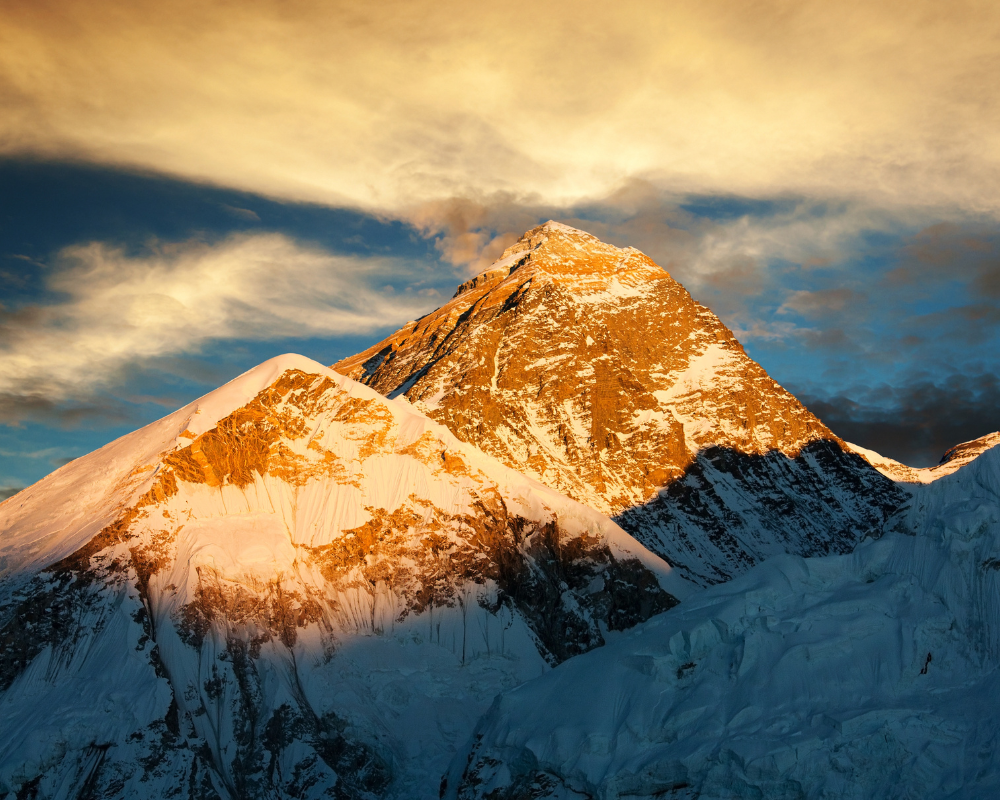
Most guides only talk about sunrise, but Kala Patthar actually rewards both ends of the day differently, and the choice affects your schedule, your gear, and even your safety margin.
| Factor | Sunrise | Sunset |
|---|---|---|
| Classic "golden Everest" shot | Yes, first light hits the summit pyramid directly, producing the shot most photos use | Softer, warmer light on the western faces, but Everest itself can fall into shadow earlier than nearby peaks |
| Departure time | Leave Gorak Shep in full darkness, roughly 2–3 hours before sunrise | Leave in the afternoon with daylight the whole way up |
| Temperature | Coldest point of the day, often well below freezing with wind chill | Milder than pre-dawn, but temperatures drop fast once the sun dips |
| Crowd levels | Busiest; most trekkers time their climb for sunrise | Quieter, since fewer people schedule a second climb |
| Descent conditions | Descend in daylight, which is easier on the loose scree | Descend in fading light or darkness, requiring a headlamp |
| Overall difficulty | Harder start (cold, dark, tired legs) but easier finish | Easier start but a harder, riskier finish in low light |
| Best for | Photographers who want the iconic postcard shot | Trekkers who prefer smaller crowds and don't mind a different light palette |
If you can only do one, sunrise is still the classic choice and the reason most itineraries build in a pre-dawn Kala Patthar push. But if your schedule allows a rest day at Gorak Shep, a sunset climb is a genuinely underrated alternative with far fewer people at the top.
How to Prepare for the Climb
Kala Patthar is not technical, but it is a high-altitude push at the end of days of accumulated fatigue. Preparation matters more than raw fitness.
- Acclimatize properly on the way up, including rest days at Namche Bazaar and Dingboche
- Start in darkness with a reliable headlamp and spare batteries, since the pre-dawn ascent is the standard approach
- Layer for extreme cold, since pre-sunrise temperatures at this elevation regularly drop well below freezing even in trekking season
- Pace deliberately on the scree and loose rock near the top, where footing gets unstable
- Carry water that will not freeze, using an insulated bottle or a bladder tube kept close to the body
- Know the signs of altitude sickness and be willing to turn back if symptoms appear
Can a Beginner Trek to Kala Patthar?
Yes, with the right caveats. Kala Patthar requires no climbing skills, ropes, or technical experience. Anyone with reasonable fitness and enough time to acclimatize properly can reach the top. It's a walking and scrambling route the whole way, not a mountaineering objective.
That said, "beginner-friendly" here means beginner-friendly at altitude, which is a different challenge than beginner-friendly on flat ground:
- Fitness matters less than acclimatization. A moderately fit person who takes rest days and ascends slowly will often outperform a very fit person who rushes the itinerary.
- You'll have days of trekking behind you already. Kala Patthar comes near the end of the roughly 12–14 day Everest Base Camp trek, so by the time you reach it, your body has had time to adjust to lower altitudes first, so you're not attempting this cold.
- The final push is the hardest part, not the whole trek. The steep, loose final stretch to the viewpoint is short but demanding; going slowly and stopping to catch your breath is normal, not a sign you're unfit for it.
- A guide or group is strongly recommended for first-timers. Not because the terrain is technical, but because recognizing altitude sickness in yourself is notoriously unreliable, and a guide or experienced companion catches warning signs you might miss.
- Prior high-altitude experience helps but isn't required. Plenty of first-time trekkers with no mountain background reach Kala Patthar successfully every season, provided they respect the acclimatization schedule.
The honest bottom line: beginners succeed here regularly, but the limiting factor is almost never leg strength; it's patience with the acclimatization schedule and being willing to turn back if your body says no.
Challenges of Climbing Kala Patthar
Even without technical difficulty, several things make this climb harder than its short distance suggests:
- Altitude, above everything else. At nearly 5,650 meters, oxygen levels are roughly half of what they are at sea level. Even trekkers who feel fine at Base Camp can struggle here.
- Extreme cold, especially pre-dawn. Temperatures regularly fall well below freezing before sunrise, and wind chill at the exposed summit makes it feel colder still.
- Loose, unstable footing. The final stretch is steep scree and rock rather than a maintained trail, which is tiring and easy to slip on, particularly on tired legs in the dark.
- Accumulated fatigue. Kala Patthar typically comes after a week or more of daily trekking, so you're climbing on legs that are already worn down.
- Thin margins for error. Because it sits at the very top of the itinerary, there's little buffer left if you're behind schedule, unwell, or the weather turns, so most trekkers get one real shot at the summit.
- Weather can close the view without warning. Cloud cover, especially outside autumn and spring, can roll in and block the exact view you climbed for, even after a clear start.
- Basic facilities nearby. Gorak Shep, the staging point, has minimal amenities, so recovery and rest before or after the climb are limited compared to lower villages.
- Regional headlines don't always mean regional impact. Flooding, landslides, or other events elsewhere in Nepal occasionally raise questions for trekkers about whether the Khumbu is affected; it's worth checking current trail and flight conditions rather than assuming the worst from a distant news story.
What the Ascent Actually Feels Like
Departing Gorak Shep in the dark, the trail climbs steadily over rock and scree. The final stretch to the summit ridge is the steepest section of the entire Everest Base Camp trek, short in distance but demanding at nearly 5,650 meters of elevation. Most trekkers move slowly here, stopping often to catch their breath.
At the top, the reward is immediate. Everest's summit rises above Nuptse's ridge, catching the first sunlight while the valley below is still in shadow. It is cold, it is windy, and for most people who have spent a week and a half getting here, it is the moment the entire trek was building toward.
Final Word
Kala Patthar is optional on paper but essential in practice for anyone who wants the view that defines the Everest Base Camp trek in the popular imagination. It costs you an early, freezing wake-up call and a steep, breathless final scramble on legs that have already carried you for over a week, and it gives back a view that very few places on the planet can match: Everest's summit standing fully exposed, flanked by Lhotse, Nuptse, Pumori, and Changtse, with the Khumbu Glacier and the tents of Base Camp laid out far below.
Base Camp gives you the history and the milestone, the spot where climbing legends have staged their expeditions for a century and where the trek's name and purpose come from. But Base Camp was never designed to be a viewpoint, and its flat boulder field, boxed in by the Khumbu Icefall and Nuptse's wall, was never going to deliver the postcard shot. Kala Patthar was. It turns a trek that could end on a slightly anticlimactic note, standing among rocks and prayer flags, into one that finishes on a genuine high point, literally and emotionally.If you only have the energy or the weather window for one summit push near the end of your trek, make it this one. Base Camp gives you the story you'll tell for years. Kala Patthar gives you the photograph, the panorama, and the moment that makes the entire journey feel worth every step, the mountain, in full view, exactly the way you imagined it before you ever set foot in the Khumbu.
Getting the logistics right matters just as much as the view itself, since a rushed itinerary is the single biggest reason trekkers miss out on a clear summit morning. Local Kathmandu-based operators such as Outshine Adventure build their Everest Base Camp itineraries around exactly this kind of pacing: enough acclimatization days at Namche Bazaar and Dingboche, experienced Sherpa guides who know how to read both the weather and a trekker's fitness on summit morning, and a schedule with enough flexibility built in that a cloudy sunrise doesn't mean a missed view entirely. Outshine Adventure is a government-registered, Nepal-based trekking agency founded by guides with years of firsthand experience on these exact trails, and it also directs a share of its trip profits to local community charities in the areas trekkers pass through. Whether you plan the trek independently or go with an outfitter, the principle is the same: the mountain rewards patience far more than it rewards speed.