Langtang Valley TrekkingLangtang Valley Trekking

Langtang Valley Trekking

  • Duration9 Days
  • Destination Nepal
  • Difficulty Level Strenuous
  • Maximum Altitude 3,798m.
  • Activity Trekking
  • Group Size 1-50
  • Accommodation Local Guest Houses.
  • Meals Breakfast, Lunch & Dinner.
  • Best Time September to late December and February to late June.

Trip Highlights

  • Spectacular Himalayan views, including Langtang Lirung and surrounding snow peaks
  • Scenic trekking trails through forests, rivers, and alpine landscapes
  • Exploration of traditional Tamang villages and mountain culture
  • Visit to the historic monastery at Kyanjin Gompa
  • Opportunity to hike to panoramic viewpoints like Kyanjin Ri and Tserko Ri
  • Wildlife encounters inside Langtang National Park including red panda habitat
  • Short travel distance from Kathmandu compared to other Himalayan treks
  • Authentic teahouse trekking experience with local hospitality.

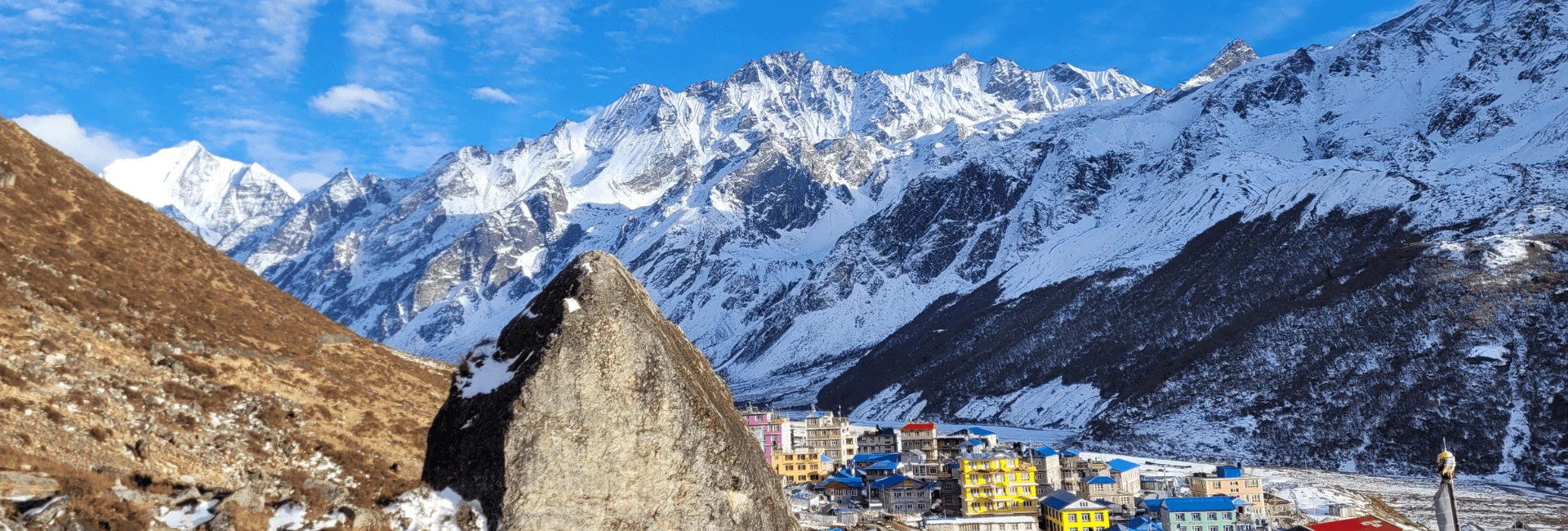
The Langtang Valley Trek is a beautiful place to go in the Himalayas, just north of Kathmandu inside Langtang National Park. They call it the "Valley of Glaciers" because it has snow-covered mountains like Langtang Lirung and Dorje Lakpa, clean rivers, high meadows, and thick forests. The Langtang Valley Trek has a lot of beauty; you can learn about the local culture, and the walking is not too hard, so it is great for people who are new to trekking and for people who have done it before.

When you are walking on the trail, you can see wildlife that lives in the Himalayas, like monkeys, musk deer, Himalayan black bears, red pandas, and many kinds of birds, including the monal, which is the national bird of Nepal. If you get up early in the morning or walk on parts of the trail, you are more likely to see these animals, which is great for people who love nature.

The Langtang Valley is where the Tamang villages live, and their way of life is similar to Tibetan traditions. When you are trekking, you will see monasteries, prayer flags, stone walls with prayers on them, and fields with crops and yaks eating grass. The local teahouses are very welcoming; they serve food, and you can learn about what life is like in the villages. Compared with popular routes like the Everest Base Camp orAnnapurna Base Camp treks, Langtang Valley offers a quieter and less crowded alternative, yet equally spectacular scenery.

The trek goes from the part of the valley to Kyanjin Gompa, which is 3,740 meters high, and you will pass by the Yala Cheese Factory lakes in the mountains and the Langsisa pastures, which are 4,084 meters high and have glaciers and amazing views. If you want to, you can also climb Kyanjin Ri to see the Himalayan range from all sides.

The best time to go trekking is from March to May and from September to December because the weather is nice and the views are really beautiful. The Langtang Valley Trek is an experience because you can make your own schedule, the scenery is amazing, there is a lot of wildlife, and the local people are very friendly, so it is a trip you will never forget in theLangtang Valley.

Why Choose the Langtang Valley Trek

Many trekkers choose the Langtang Valley Trek because it provides an authentic Himalayan experience without requiring long travel times or extremely high altitudes. The trail begins with a scenic drive from Kathmandu to the small town of Syabrubesi, which serves as the gateway to Langtang Valley. From there, the trek follows the Langtang River through dense forests and gradually climbs toward the high mountain valley.

One of the most appealing aspects of this trek is its diversity. The lower sections of the trail pass through beautiful forests where birds and wildlife are commonly seen, while the upper valley opens into wide alpine landscapes surrounded by glaciers and towering peaks. Each day reveals new scenery and unique cultural encounters.

Another reason the Langtang Valley Trek stands out is the cultural experience. The Tamang communities living in this region share a heritage closely connected to Tibetan Buddhism. Prayer wheels, mani walls, monasteries, and colorful prayer flags appear frequently along the trail, creating a spiritual atmosphere that adds meaning to the trekking journey

Culture and Local Life in Langtang

The people living in Langtang Valley belong primarily to the Tamang ethnic group. Their traditions, language, and religious practices share strong connections with Tibetan culture. Throughout the trek, visitors can observe monasteries, prayer wheels, chortens, and stone walls engraved with Buddhist mantras.

Hospitality is an important part of local life in the mountains. Trekkers staying in traditional teahouses often experience warm welcomes and home-cooked meals prepared by local families. This cultural interaction makes the journey more meaningful and provides insight into daily life in the Himalayas.

Wildlife and Nature in Langtang National Park

The trekking route passes through Langtang National Park, one of Nepal’s most important protected areas. The park covers a wide range of ecosystems, from subtropical forests to alpine environments.

Wildlife in the region includes rare and fascinating species such as the red panda, Himalayan black bear, musk deer, and Himalayan tahr. Bird enthusiasts may also encounter a variety of colorful Himalayan bird species along the trail.

The forests are especially beautiful during spring when rhododendron flowers bloom across the hillsides, creating vibrant colors throughout the landscape.

Langtang Valley Trek Difficulty

The Langtang Valley Trek is considered a moderate trekking route. It does not require technical climbing skills, but trekkers should be prepared for several days of walking at increasing altitudes.

The highest point of the trek is usually the viewpoint hike to Tserko Ri, which reaches an elevation of approximately 4,984 meters. Proper acclimatization and a steady walking pace are important for enjoying the trek safely.

Most people with good physical fitness and preparation can complete the trek successfully.

Food and Accommodation

Accommodation along the Langtang trekking route is mainly provided by traditional mountain teahouses. These lodges offer simple but comfortable rooms and warm meals prepared with locally available ingredients.

Typical meals include rice, lentils, vegetables, noodles, soups, potatoes, and Tibetan bread. Many lodges also serve international trekking dishes such as pasta and pancakes. Hot drinks like tea, coffee, and ginger lemon honey are commonly available.

Staying in these family-run lodges provides an authentic experience and helps support local communities in the region.

Culture and Local Life in Langtang

The people living in Langtang Valley belong primarily to the Tamang ethnic group. Their traditions, language, and religious practices share strong connections with Tibetan culture. Throughout the trek, visitors can observe monasteries, prayer wheels, chortens, and stone walls engraved with Buddhist mantras.

Hospitality is an important part of local life in the mountains. Trekkers staying in traditional teahouses often experience warm welcomes and home-cooked meals prepared by local families. This cultural interaction makes the journey more meaningful and provides insight into daily life in the Himalayas.

Langtang Valley Trek: a quieter side of the Himalayas that feels more real

And not everybody loves crowds, which is where the Langtang Valley trek really shines. Very close to Kathmandu, easily reachable, but once on the trail gives a feeling of not crowded and very commercial.

Indeed, this is one of the reason many trekkers chose Langtang; simpler in fact, less cluttered, less people and include more direct connection with mountains and village life.

Langtang Valley Trekking Itinerary

01Day

    The adventure begins early, pulling out of the Kathmandu Valley while the morning air is still cool and the city is just waking up. The government-designated hill route carries you first through Tokha, on the valley's northern edge, then climbs into quieter terrain through Chhahare and across the Gadkhar Bridge, where the sound of a rushing stream below marks your first real sense of leaving the city behind. From here, the road winds through a string of small hill settlements: Aapre, Narja, Lachyang, Sarmathali, Patikharka, and Bogtitar, each surrounded by terraced fields cut into the hillsides, farmers tending crops much as they have for generations, and views that open and close as the road curves along the ridgelines. Forest cover thickens the higher you climb, with pine and rhododendron lining the route, until the road crests near Kalikasthan and begins its final descent into Dhunche, the headquarters of Rasuwa district and your gateway to the Langtang region. It is a long day on the road, but one filled with the kind of unhurried, off-the-beaten-path scenery most trekkers never get to see, and you'll arrive in Dhunche as evening settles over the surrounding hills

    02Day

      Leaving the roadhead behind, the trail begins its climb toward Thulo Syabru, a village perched high on a ridge with sweeping views back across the valley you just drove through and out toward the surrounding hills of Rasuwa. It's a shorter, steadier day than what follows, a gentle introduction to trekking at altitude before the trail drops into forest tomorrow. Arriving in Thulo Syabru by early afternoon leaves time to settle into the teahouse, wander the village's stone lanes, and take in the views before the trail turns downhill into the Langtang Khola valley.

      03Day

        From Thulo Syabru, the path drops down into dense subtropical forest, where sunlight filters through a canopy of oak, rhododendron, and bamboo, and the calls of birds, along with the occasional rustle of langur monkeys in the branches overhead, accompany your walk. The trail hugs the Langtang Khola for much of the way, crossing swinging suspension bridges over the glacial-fed river as it winds gradually upward. By late afternoon, the cluster of teahouses at Lama Hotel comes into view, tucked into the trees, a warm and welcoming stop for your first night truly immersed in the mountains.

        04Day

          The trail continues climbing steadily through forest that slowly begins to change character, passing Riverside, where the river's roar is a constant companion, and Ghoda Tabela, a former army post and horse-grazing meadow that opens into your first real sense of the valley's scale. Continuing on through Thangshyap, the dense forest gradually gives way to more open terrain, and for the first time the high peaks surrounding the valley come clearly into view, a striking moment after two days spent mostly under tree cover. Langtang Village itself, at roughly 3,430 meters, holds a special resonance. Rebuilt with quiet determination after the 2015 earthquake, it stands today as a living testament to the strength of the Tamang communities who call this valley home, and its warmth and hospitality make for a memorable overnight stop.

          05Day

            The trail climbs higher still, passing through the small settlements of Mundu and Sindum, where the valley begins to widen dramatically and yak herds graze across open pastureland. The surrounding peaks close in more tightly here, creating a genuine sense of standing deep within the high Himalaya. By the time you reach Kyanjin Gompa, at 3,850 meters, the full grandeur of the upper valley is on display: a centuries-old Buddhist monastery framed by the towering, glaciated wall of Langtang Lirung rising almost directly overhead, and a small, welcoming settlement that has long served as base camp for exploring the valley's highest reaches.

            06Day

              A day built for both rest and reward. Most trekkers use this acclimatization stop to climb higher for even better views. Kyanjin Ri offers a shorter, more accessible ascent with a strong panoramic payoff, while the more demanding climb to Tserko Ri rewards those who make the effort with a sweeping 360-degree view stretching across Langtang Lirung, Langshisha Ri, and a seemingly endless procession of snow-capped ridgelines toward the Tibetan border. Either route offers a chance to properly acclimatize while taking in some of the most spectacular mountain scenery of the entire trek before returning to Kyanjin Gompa for a well-earned rest.

              07Day

                The descent begins, retracing your steps back down through Sindum, Mundu, Langtang Village, Thangshyap, and Ghoda Tabela. Walking the same trail in reverse offers a surprisingly different experience. Details missed on the climb up now catch your eye, the light falls differently across the valley, and there is a quiet satisfaction in covering familiar ground with the summit views still fresh in memory. By evening, the forested surroundings of Lama Hotel welcome you back for the night.

                08Day

                  The final trekking day brings a mix of nostalgia and accomplishment as the trail climbs back up through the same forest trails, crossing the Langtang Khola's suspension bridges one last time, birdsong and the rustle of langur monkeys accompanying the walk back to Thulo Syabru, a last chance to soak in the sounds and scenery of the valley on foot. From Thulo Syabru, rather than trekking the remaining descent, a short jeep transfer carries you down to Dhunche, easing you back into the world of roads and vehicles and leaving time to rest before tomorrow's longer drive to Kathmandu.

                  09Day

                    The journey concludes with the return drive along the same government-designated route, retracing your path back through Kalikasthan, Bogtitar, Patikharka, Sarmathali, Lachyang, Narja, Aapre, the Gadkhar Bridge, Chhahare, and Tokha, before finally arriving back in Kathmandu. It is a long day of travel, but one that closes out the trip with the same unhurried, scenic hill roads that opened it. Mountain memories, and a little trail dust, come along for the ride.


                    After the devastating floods in Nepal, the route to Langtang Valley via Syabrubesi was completely closed. Therefore, we have introduced an alternative trekking route via Dhunche and Thulo Syabru to Langtang Valley, using a different route to continue the trek

                    Cost Details

                    Price Includes

                    To quote you an exact or approximate price, we need the number of persons in your group, the category of hotel, the mode of transportation (by plane or by bus or by jeep, etc.), & any alternations in your itinerary. Please contact us with these important details first so that we can get back to you on the cost.

                    • Airport / hotel / airport pickup & drop-off by private car / van / bus.
                    • Standard accommodation at a hotel in Kathmandu.
                    • Guided city tour in Kathmandu by car / van / bus if you require Kathmandu sightseeing.
                    • All your standard meals (breakfast, lunch, and dinner) during the trek.
                    • Best available guesthouse accommodation during the trek.
                    • local government-licensed English-speaking guide during the trek.
                    • The required number of staff and porters to carry your luggage during the trek.
                    • Food, accommodation, salary, insurance, equipment, medicine, and transportation for all trekking/tour staff.
                    • Langtang National Park permits.
                    • Down jacket, sleeping bag, and duffel/kit bag by Outshine Adventure Trekking.
                    • Surface transfer from and to Kathmandu.
                    • All our government taxes.

                    Price Excludes

                    • Lunch and dinner whilst in Kathmandu.
                    • Your travel insurance.
                    • Alcoholic and hot and cold drinks and laundry.
                    • Personal trekking equipment.
                    • Tips for trekking staff and driver—Tipping is expected.
                    • Any other expenses except your trek.
                    Dates & Availability
                    Start DateEnd DateStatusPrice 
                    Start DateStarts: TuesdaySep 29, 2026Group JoiningEnd DateEnds: WednesdayOct 07, 2026StatusStatusAvailablePricePriceUS$650
                    Start DateStarts: WednesdaySep 30, 2026Group JoiningEnd DateEnds: ThursdayOct 08, 2026StatusStatusAvailablePricePriceUS$650
                    Private Trip

                    Useful Information

                    Permits Required

                    • Langtang National Park Entry Permit
                    • TIMS Card (Trekkers’ Information Management System)

                    Best Time to Trek

                    • Spring (March–May) – Clear skies, rhododendron flowers
                    • Autumn (September–November) – Best mountain views
                    • Winter and monsoon conditions

                    Moderate trekking difficulty

                    • Daily walking hours (5–7 hours)
                    • Maximum altitude at Kyanjin Gompa
                    • Altitude and Acclimatization
                    • Risk of Acute Mountain Sickness
                    • Importance of slow ascent and rest days
                    • Internet, Charging & Communication
                    • Wi-Fi availability in some teahouses
                    • Charging fees for phones and cameras

                    Packing List

                    • Trekking boots
                    • Warm clothing
                    • Sleeping bag
                    • Trekking poles
                    • Water purification tablets
                    • Transportation

                    Insurance covering high-altitude trekking and emergency evacuation

                    Langtang Valley Trekking Reviews

                    • B
                      Beatriz GarnerChile,November 29, 2024
                      rating star

                      Best Arrange by Goku

                      Langtang Valley is one of Nepal's more accessible and frequently visited trekking routes. This region, which suffered severe damage during the 2015 earthquake, has since recovered and remains a popular destination. Most trekkers follow the same route, hiking to the upper valley, spending a day or two exploring, and then returning along the same trail. The journey typically takes 8 to 10 days at a comfortable pace.

                      Posted onGoogle
                    • C
                      Christen SUnited States,November 19, 2024
                      rating star

                      Fascinating Langtang Valley Trek

                      A gentle trek with fantastic views, pristine landscape, and friendly mountain people overlooking the mountains in Langtang Area. Great Company

                      Posted onGetYourGuide
                    • Anna M
                      Anna MUnited States,February 11, 2024
                      rating star

                      Great Company even great guides and great trek!

                      My sister and I went on a trek with Outshine in January. We went to the Langtang Valley and had an amazing time. Outshine made everything easy. Gokul and Asmita were helpful and responsive organizing logistics and getting us ready. The hike was unbelievably beautiful but the real highlight was getting to spend the week with our guide Som and porter Prakass. They were so kind, professional, funny, smart and fun. They taught us so much about the region history, ecology and cultures and were patient enough to teach us Nepali and let us try to use it!! We knew our guides would be great, but we didn’t expect them to be so funny and fun! They kept us laughing so hard. We felt very looked after, cared for, and safe with their guidance. We couldn’t have imagined a better experience and if we return to Nepal someday we will absolutely hire Outshine Adventures again. Thank you Gokul, Asmita, Som and Prakass! It was a experience we will never forget.

                      Posted onTripAdvisor
                    Tripadvisor

                    Similar Trips

                    You may also like this packages
                    Still, looking for your next holiday?

                    Let us help you plan your dream vacation, with personalized itineraries and expert advice.

                    Plan Your Trip